
Glide Reflection Cats: Combining Translation and Mirror
Loading the math board and drawing, please wait…
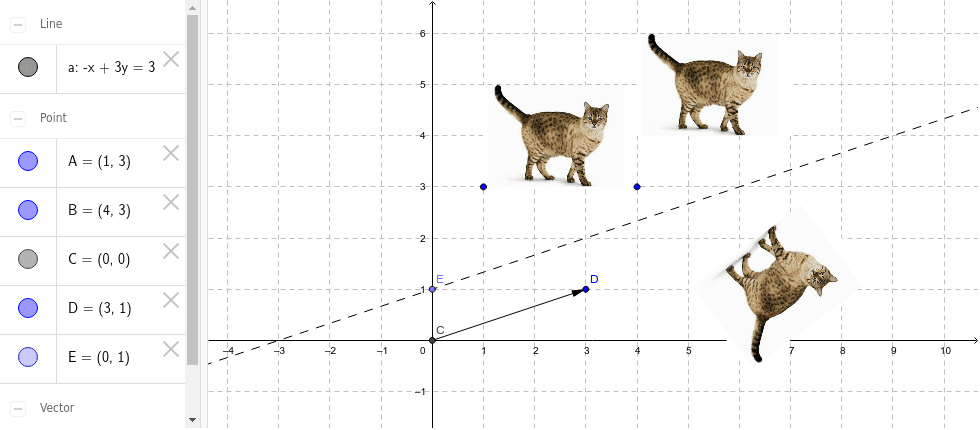
① This example demonstrates the glide reflection, a composite geometric transformation, by applying a translation followed by a reflection to cat images, producing a symmetric pattern of cats. ② The core mathematical concepts include translation, reflection, and their composition, involving vectors, axes of symmetry, and properties of transformations. ③ Construction highlights: Based on the construction summary, GeoGebra commands such as Intersect, Vector, Translate, Point, Line, and Mirror are used, with objects A, B, C, D, E, vector u, and picture objects pic1, pic1', and pic1'' defined to generate the glide-reflected cat sequence through successive translations and reflections. ④ Suitable for middle school geometry or introductory college transformation courses, this example helps students grasp the geometric meaning of composite transformations and can serve as an engaging art-math integration activity to foster interest in symmetry and translation.
GeoGebra Commands & Parameters
Intersect(xAxis, yAxis) → CVector(C, D) → uTranslate(pic1, u) → pic1'Point(yAxis) → ELine(E, u) → aMirror(pic1', a) → pic1''
AI Drawing Prompt Reference
Draw a symmetric pattern of cats by combining translation and reflection. Start with a cat image at the origin, then translate it along a vector from the origin to another point to get a new cat. Next, find a point on the y-axis and draw a line through it parallel to the translation vector. Finally, reflect the new cat over this line to create the symmetric cat pattern.
The prompt above was compiled from the original drawing commands and is for reference only.