
Geometric Proof of the Sine Addition Formula (Improved)
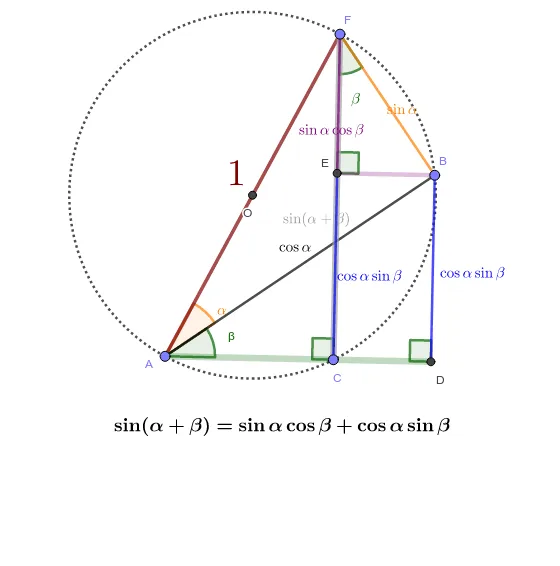
This GeoGebra applet provides an intuitive, visually engaging, and rigorous geometric proof of the sine addition formula, sin(α + β) = sin(α)cos(β) + cos(α)sin(β). By carefully constructing circles, line segments, perpendicular lines, and specific angles, the applet builds a comprehensive geometric model that elegantly incorporates two individual angles, α and β, as well as their sum, α + β. The fundamental trigonometric identity is derived step-by-step through observable geometric relationships, specifically by analyzing the decomposition of triangle areas and the projection of orthogonal segment lengths. This improved version of the classic geometric proof features a streamlined, highly logical construction. It eliminates the unnecessary visual clutter often found in standard textbook diagrams, making the deductive reasoning exceptionally clear and easy to follow. The interactive nature of the GeoGebra environment allows students to dynamically adjust the measures of angles α and β by simply dragging control points on the canvas. As the angles change, all dependent geometric figures, segment lengths, and area calculations update in real time. This dynamic feedback loop visually confirms that the algebraic identity holds true universally, regardless of the specific angle measures chosen. The educational benefits of this applet are substantial, particularly for high school and early undergraduate college students. It effectively bridges the critical gap between abstract algebraic manipulation and concrete geometric intuition. Instead of relying on the rote memorization of trigonometric formulas, learners can visually deconstruct the sine addition formula and see exactly why it works. By observing how the sine of a combined angle can be represented as a sum of products involving the sines and cosines of the individual angles, students foster a deeper, more profound understanding of the intrinsic connections between geometric properties and algebraic identities. Furthermore, interacting with this model helps students develop stronger spatial reasoning skills, reinforces the definitions of trigonometric ratios in right triangles and the unit circle, and provides a robust conceptual foundation that will serve them well in more advanced mathematics courses, including calculus, linear algebra, and complex analysis.
In collections
Vocational High School Mathematics
Loading the math board and drawing, please wait…