
Geometric Definition of a Parabola: Locus Equidistant from a Point and a Line
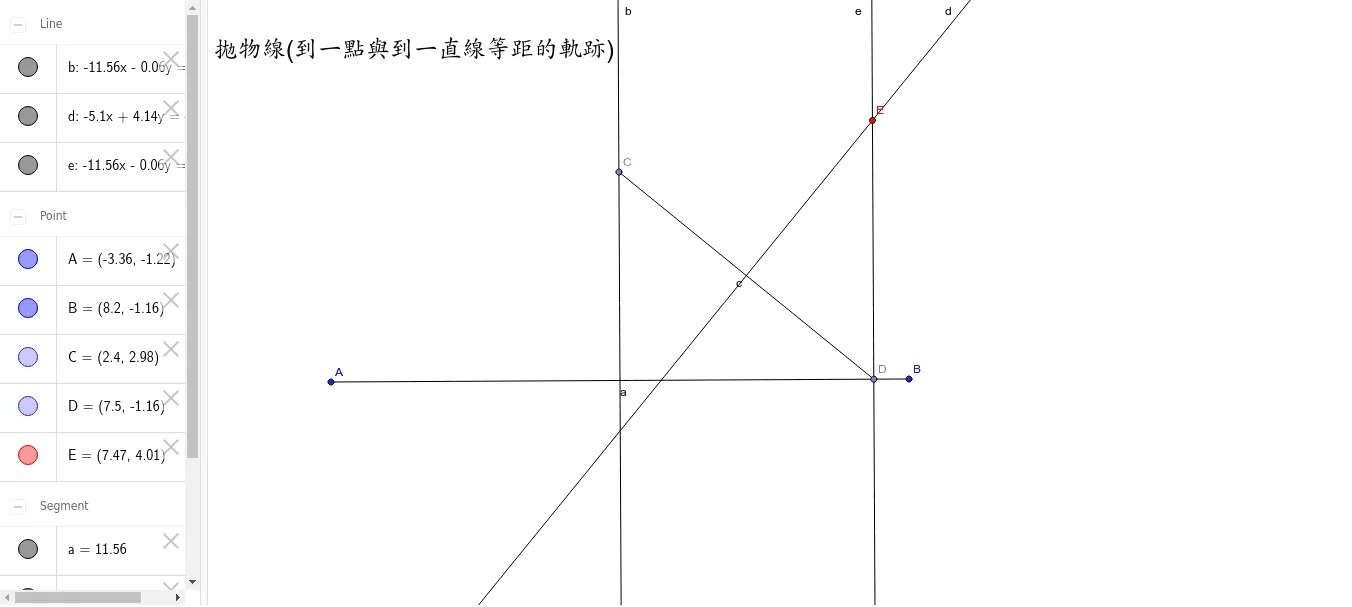
This GeoGebra applet dynamically demonstrates the geometric definition of a parabola, which is the locus of all points in a plane that are equidistant from a fixed point called the focus and a fixed line called the directrix. The model uses a series of geometric construction commands including segments, perpendicular bisectors, orthogonal lines, and intersection points to build a moving point on the parabola and visually illustrate its distance relationship to both the focus and the directrix. As the user drags the construction point along the directrix or manipulates the focus position, the applet实时更新 the parabola curve and the associated auxiliary lines in real time, providing an intuitive and interactive exploration of one of the fundamental conic sections. The perpendicular bisector between the focus and any point on the directrix always forms a tangent to the parabola at the corresponding locus point, a key property that connects classical Euclidean geometry with analytic geometry. This visualization helps students develop a deep geometric understanding of why the parabola takes its characteristic U-shaped form and how the defining property of equal distances gives rise to its algebraic equation y = ax² + bx + c. The interactive nature of the applet allows learners to experiment with different focus-directrix configurations, observe how changes in the distance between the focus and directrix affect the width and orientation of the parabola, and connect the synthetic geometric view with the coordinate-geometric formulation. It is an excellent teaching tool for high school and introductory college courses in analytic geometry, conic sections, and locus problems, bridging the gap between abstract definitions and concrete visual intuition.
Loading the math board and drawing, please wait…