
Geometric Construction with Polygons and Perpendicular Line Intersections
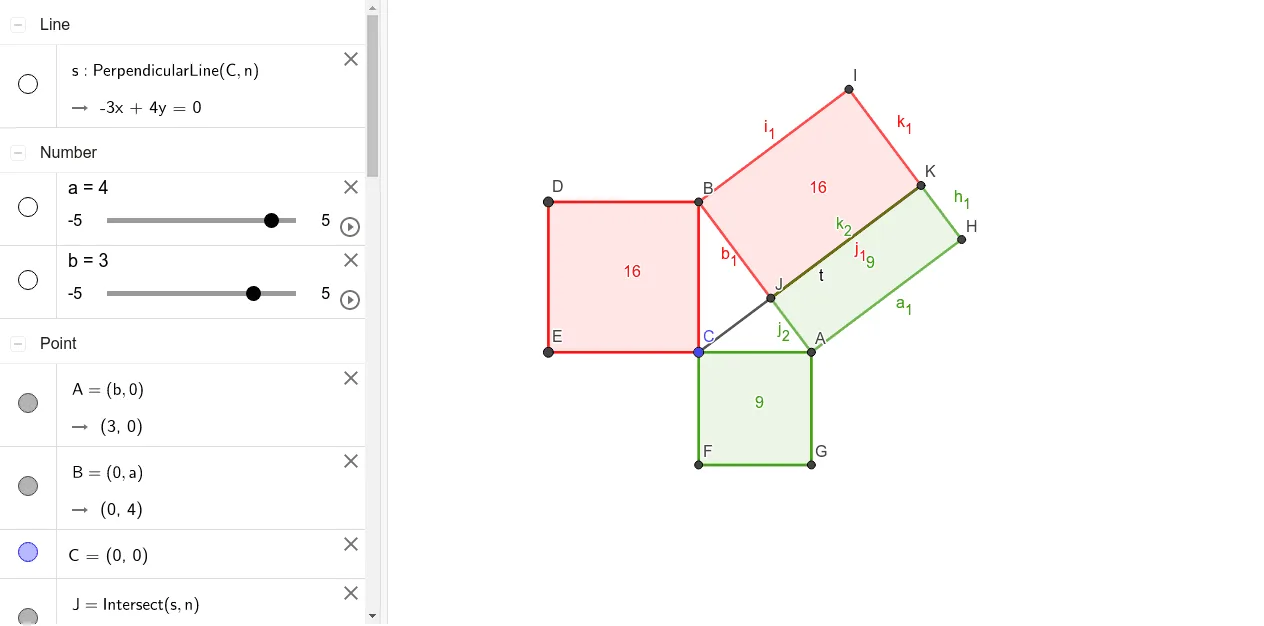
This GeoGebra applet demonstrates geometric construction involving polygons and perpendicular lines. The interactive model creates multiple polygons—named poly1, poly2, and poly3—using the Polygon command as the foundational step. From selected key vertices on these polygons, perpendicular lines are constructed using the OrthogonalLine command, dropping perpendiculars from strategic points to opposite sides or extended lines of the polygons. The intersections between these perpendiculars and the polygon edges are then computed using the Intersect command, producing new construction points that reveal important geometric relationships.
The construction involves eleven key points labeled A through K, each serving a specific role in the overall geometric figure. Additional auxiliary lines are introduced throughout the process to support the construction, creating a rich network of intersecting segments that illustrate core concepts of Euclidean geometry. Segment commands are used to connect relevant points, forming visible geometric relationships that students can observe and manipulate.
By adjusting the positions of the defining vertices with the drag feature, students can explore how the perpendiculars and their intersection points move dynamically while preserving the underlying geometric constraints. This interactivity reinforces the invariant properties of the construction, such as angle relationships, concurrency patterns, and symmetry, that hold regardless of the specific configuration chosen.
The applet is designed for plane geometry instruction and inquiry-based learning. It helps students visualize abstract geometric theorems involving altitudes, perpendicular bisectors, and orthocenters, while also developing spatial reasoning skills through hands-on exploration. Educators can use this tool to guide classroom discussions about polygon properties, the significance of perpendicular constructions, and the geometric meaning of intersection points derived from orthogonal projections.
Students benefit by gaining intuitive understanding of how perpendicular lines interact with polygonal structures, observing the emergence of classical geometric centers, and practicing the logical sequence of construction steps that underpin formal proofs in Euclidean geometry. The multi-layered nature of the construction—with its combination of polygons, perpendiculars, intersections, and connecting segments—provides a comprehensive example of how computational geometry software can bring traditional ruler-and-compass constructions to life in an interactive, dynamically resizable format.
In collections
My First GeoGebra Picture Book
Loading the math board and drawing, please wait…