
Geometric Construction: Angle Bisector
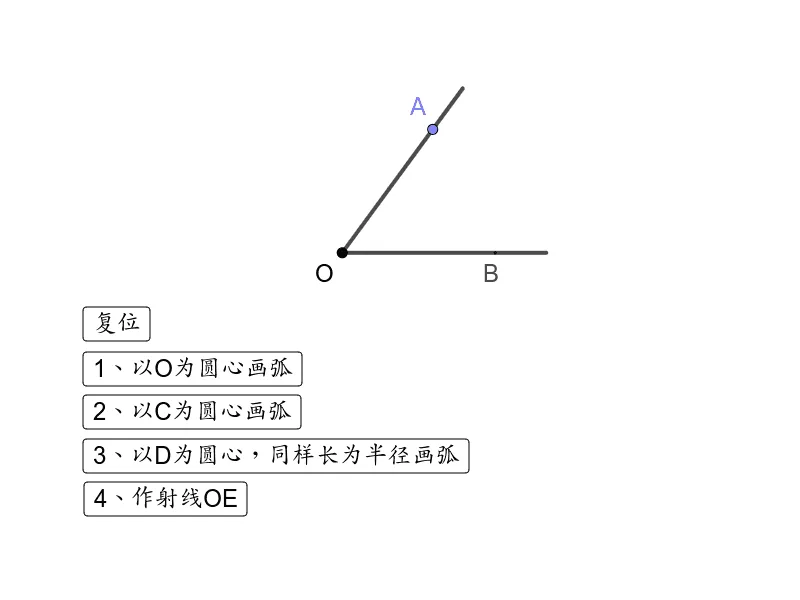
This applet demonstrates the classical compass-and-straightedge construction of an angle bisector. The user begins with an angle formed by two rays sharing a common vertex. Through a step-by-step animated process, the construction unfolds as follows: first, a circle centered at the angle vertex is drawn, intersecting both rays at two distinct points. Next, two arcs of equal radius are constructed, each centered at one of these intersection points. These arcs meet at a point interior to the angle. Finally, a line segment is drawn from the original vertex through this intersection point, producing the angle bisector.
The applet uses GeoGebra's geometry tools including circles, arcs, intersection points, and line segments to visually build each stage of the construction. Students can follow the animation at their own pace or interactively manipulate the angle by dragging its vertices, observing how the bisector adjusts dynamically while maintaining its defining property.
The underlying mathematical principle is grounded in triangle congruence. The construction creates two triangles that share a common side and have pairwise equal sides, satisfying the Side-Side-Side (SSS) congruence criterion. Because corresponding angles of congruent triangles are equal, the resulting line divides the original angle into two congruent angles, which is precisely the definition of an angle bisector.
This visualization supports multiple learning outcomes. Students gain intuition about why compass-and-straightedge constructions work rather than merely memorizing procedural steps. The dynamic interaction reinforces the connection between algebraic reasoning and geometric proof. Educators can use the applet as a teaching aid during lessons on classical constructions, triangle congruence, or the foundational properties of angle bisectors. The clear sequential presentation also helps learners who struggle with abstract geometric reasoning by providing concrete visual evidence at every stage of the proof.
In collections
Points, Lines, and Angles
Loading the math board and drawing, please wait…