
Geometric Construction and Exploration of a Pentagonal Prism
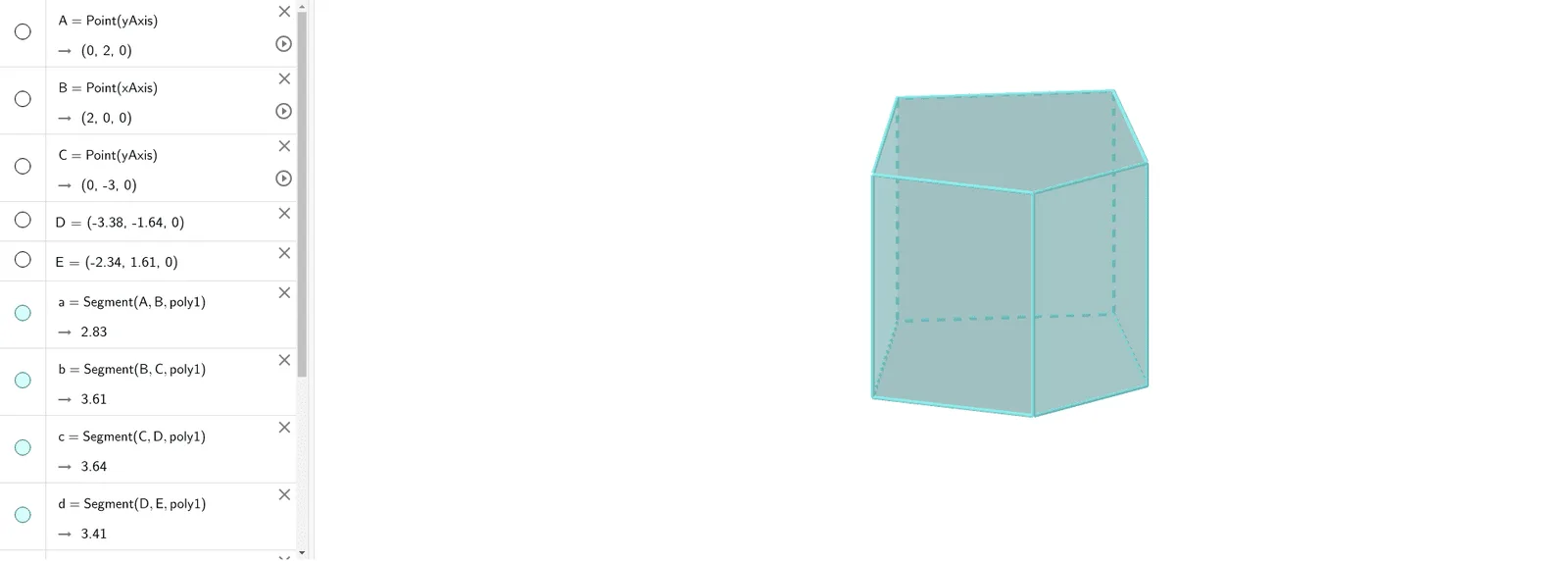
This GeoGebra example demonstrates the 3D geometric construction of a pentagonal prism. By defining the vertices of the pentagonal base (A, B, C, D, E) and generating the base polygon, it uses translation or extrusion to create the top vertices (G, H, I, J, K), subsequently constructing the lateral faces (e.g., faceABHG) and lateral edges (e.g., edgeAG). The model visually presents the structural features of a pentagonal prism, including its bases, lateral faces, vertices, and edges, helping students deepen their understanding of polyhedra in solid geometry and spatial relationships. Users can interact with the construction by toggling visibility of individual components such as faces, edges, and vertices, allowing them to isolate and examine specific parts of the prism. Dynamic sliders may control the height or displacement of the top base relative to the bottom base, enabling exploration of how the prism changes under different configurations. The applet reinforces key geometric concepts, including the properties of regular and irregular pentagons, parallel and congruent bases, perpendicular and oblique prisms, and Euler's formula for polyhedra. Students can observe how five rectangular (or parallelogram) lateral faces connect corresponding sides of the two pentagonal bases, and how ten lateral edges link the corresponding vertices. This interactive visualization supports the development of spatial reasoning skills and provides a hands-on approach to learning the fundamental characteristics of prisms, making abstract three-dimensional geometry more accessible and engaging for learners.
Loading the math board and drawing, please wait…