
Fraction Division: a ÷ b Partitive
Loading the math board and drawing, please wait…
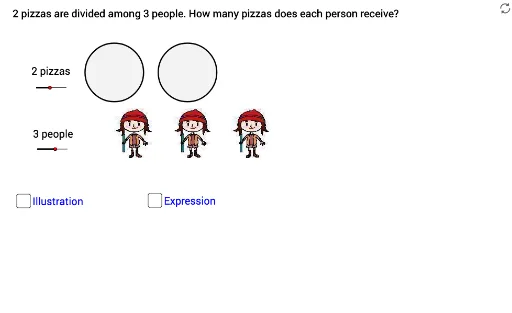
This example illustrates partitive division, where a ÷ b = a/b. Using GeoGebra commands such as Point, Segment, Sequence, and Polygon, the process of fraction division is dynamically demonstrated. Suitable for middle school and above students to learn about fraction division and partitive division.
GeoGebra Commands & Parameters
Point(Segment[(x(D) + 2 / 5, y(D)), (x(D) + 1, y(D))]) → SSegment(A, (x(A) + 1, y(A))) → l1Point(Segment[(x(A) + 1 / 5, y(A)), (x(A) + 1, y(A))]) → PSegment(B, (x(B) + 1, y(B))) → l2Point(Segment[(x(B) + 2 / 6, y(B)), (x(B) + 1, y(B))]) → QPoint(Segment[(x(C) + 1 / 6 - 0.005, y(C)), (x(Q) - 1 / 6, y(C))]) → RSegment(C, (x(C) + 1, y(C))) → l3Sequence(Circle[((2.5 * (i - 1)), 0), 1], i, 1, a) → list1Sequence(Segment[((2.5 * a), 0), ((2.5 * a) - sin((j * θ)), cos((j * θ)))], j, 1, c - 1) → list2Segment(D, (x(D) + 1, y(D))) → l4Polygon((0.016528925619834656, -3), (1.2165289256198346, -3), (1.2165289256198346, -1.3), (0.016528925619834656, -1.3)) → poly1, e, g, h, iGCD(a, d) → kSegment(A, P) → jSegment(C, R) → lSegment(B, Q) → mSegment(D, S) → nPoint(Segment[(x(A_1) + 1 / 7, y(A_1)), (x(A_1) + 1, y(A_1))]) → P_1Segment(A_1, P_1) → j_1Point(Segment[(x(D_1) + 2 / 5, y(D_1)), (x(D_1) + 1, y(D_1))]) → S_1Point(Segment[(x(A_2) + 1 / 7, y(A_2)), (x(A_2) + 1, y(A_2))]) → P_2GCD(a_1, d_1) → k_1Segment(A_2, P_2) → j_2Segment(D_1, S_1) → n_1Point(Segment[(x(D_2) + 2 / 5, y(D_2)), (x(D_2) + 1, y(D_2))]) → S_2Point(Segment[(x(A_3) + 1 / 7, y(A_3)), (x(A_3) + 1, y(A_3))]) → P_3GCD(a_2, d_2) → k_2Segment(A_3, P_3) → j_3Segment(D_2, S_2) → n_2Sequence(Sequence[CircleSector[(((-f) * sin((((2 * k) - 1) * θ / 2))) + (2.5 * (m - 1)), (f * cos((((2 * k) - 1) * θ / 2)))), (((-f) * sin((((2 * k) - 1) * θ / 2))) - sin(((k - 1) * θ)) + (2.5 * (m - 1)), (f * cos((((2 * k) - 1) * θ / 2))) + cos(((k - 1) * θ))), (((-f) * sin((((2 * k) - 1) * θ / 2))) - sin((k * θ)) + (2.5 * (m - 1)), (f * cos((((2 * k) - 1) * θ / 2))) + cos((k * θ)))], k, 1, 1], m, 1, a) → list4Sequence(Sequence[CircleSector[((f * sin((((2 * k) - 1) * θ / 2))) + (2.5 * (m - 1)), (f * cos((((2 * k) - 1) * θ / 2)))), ((f * sin((((2 * k) - 1) * θ / 2))) + sin((k * θ)) + (2.5 * (m - 1)), (f * cos((((2 * k) - 1) * θ / 2))) + cos((k * θ))), ((f * sin((((2 * k) - 1) * θ / 2))) + sin(((k - 1) * θ)) + (2.5 * (m - 1)), (f * cos((((2 * k) - 1) * θ / 2))) + cos(((k - 1) * θ)))], k, 1, b], m, 1, a) → list3
AI Drawing Prompt Reference
Draw a rectangle ABCD with point A at the origin, point B on the x-axis, point C in the first quadrant, and point D on the y-axis. Draw a line segment from point A to point P, which is 1/7 of the way along AB. Draw a line segment from point D to point S, which is 2/5 of the way along DC. Draw a line segment from point B to point Q, which is 2/6 of the way along BC. Draw a line segment from point C to point R, which is 1/6 of the way along CD. Draw a circle series with centers on the x-axis and radius 1, with centers spaced 2.5 units apart. Draw a sector series with each sector having a central angle of θ and radius f, with centers on the x-axis and centers spaced 2.5 units apart.
The prompt above was compiled from the original drawing commands and is for reference only.