
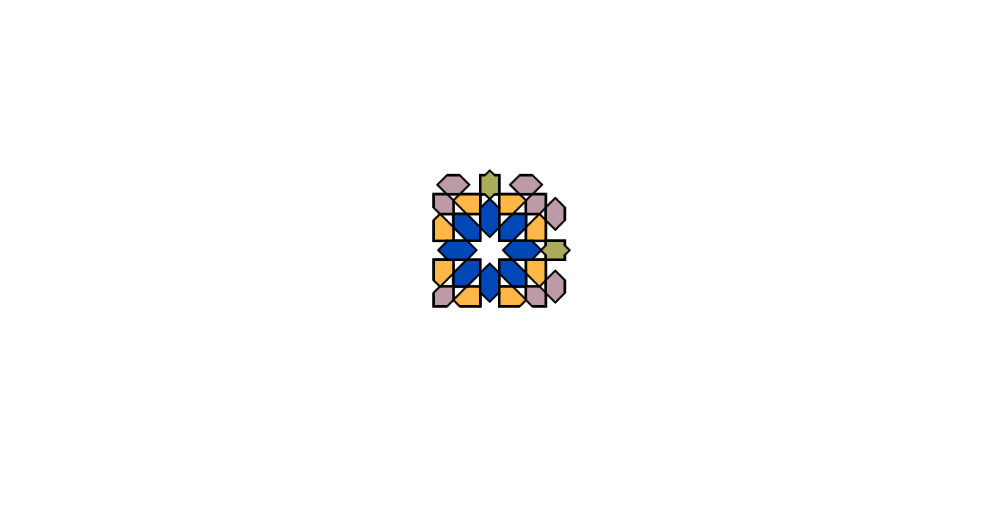
Euclidean Mosaic: Geometric Construction and Transformation
Loading the math board and drawing, please wait…
In collections
Teselaciones regulares
This example demonstrates the construction of Euclidean mosaics, highlighting geometric transformations such as translation, reflection, and rotation. Key mathematical concepts include geometric construction, transformation, and symmetry. The construction involves GeoGebra commands like Join, Translate, Mirror, Circle, and Sequence, with dynamic visualization using Intersect. Suitable for middle s
GeoGebra Commands & Parameters
Join(Sequence[Rotate[p1, (k * pi / 4)], k, 0, 7]) → lista1Translate(lista1, t) → tras1Mirror(p2, xAxis) → p2'Join(Join[Sequence[Rotate[{p2, p2'}, (k * pi / 2)], k, 0, 3]]) → lista2Translate(lista2, t) → tras2Circle((0, 0), 4) → cMirror(tras1, c) → inv1Mirror(tras2, c) → inv2Corner(1, 1) → Export_1Corner(1, 3) → Export_2Mirror(p3, xAxis) → p3'Join(Join[{Sequence[Rotate[{p3, p3'}, (k * pi / 2)], k, 0, 1], Sequence[Rotate[{p5}, (k * pi / 2)], k, 0, 3]}]) → lista3Translate(lista3, t) → tras3Mirror(tras3, c) → inv3Join(Join[Sequence[Rotate[{p4}, (k * pi / 2)], k, 0, 1]]) → lista4Translate(lista4, t) → tras4Mirror(tras4, c) → inv4Sequence({random(), random(), random()}, k, 1, númeroListas) → listaAzarSequence(If[oscuro, {1, 1, 1}, {0, 0, 0}], k, 1, númeroListas) → listaBordeMirror(negro01, y = x) → negro01'Mirror(negro02, y = x) → negro02aMirror(negro02a, yAxis) → negro02bMirror(negro02, xAxis) → negro02cJoin({Sequence[Rotate[{negro01, negro01'}, (k * pi / 2)], k, 0, 3], negro02, negro02a, negro02b, negro02c}) → negroTranslate(negro, t) → negroTMirror(negroT, c) → negro'Segment(A, B) → fSegment(C, D) → gCircle(E, 3) → dCircle(E, 3) → eIntersect(Line[F, G], Line[polígono1V(10), polígono1V(9)]) → H