
Euclid's Proof of the Pythagorean Theorem
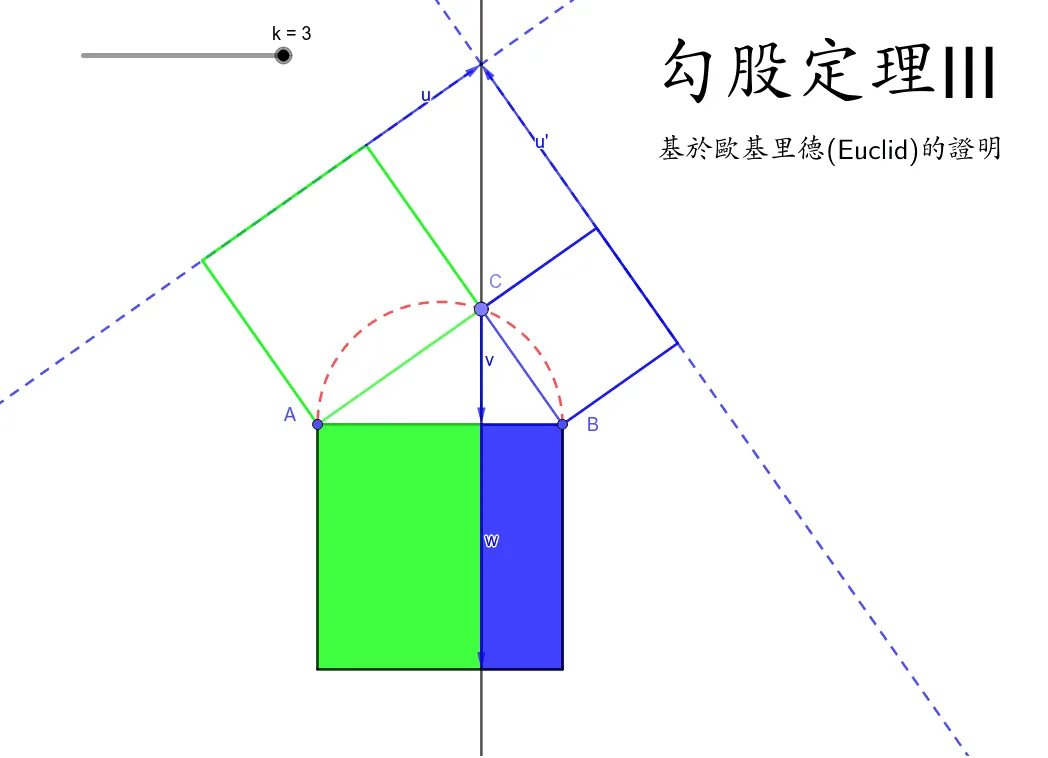
This GeoGebra applet demonstrates the classic Euclidean geometric proof of the Pythagorean theorem, also known as Euclid's Proposition 47 from Book I of the Elements. By constructing a right-angled triangle and the squares on each of its three sides, the applet visually illustrates that the sum of the areas of the squares on the two legs equals the area of the square on the hypotenuse. The proof relies on area dissection and the properties of congruent triangles, making the abstract algebraic relationship a² + b² = c² tangible through pure geometry.
The interactive construction begins with a right-angled triangle whose vertices can be dragged to adjust the lengths of the legs, allowing users to explore the theorem with various triangle proportions. Squares are automatically generated on each side of the triangle. Following Euclid's original method, a perpendicular line is dropped from the vertex of the right angle to the hypotenuse and extended through the square on the hypotenuse, dividing it into two rectangles. The applet then highlights pairs of congruent triangles that connect each rectangle to the corresponding square on a leg of the triangle. Through careful color coding and step-by-step animation, users can observe how each rectangle has the same area as its associated square, thereby proving that the two smaller squares together equal the large square in area.
Students benefit from this applet in several important ways. First, it transforms a static textbook proof into a dynamic, manipulable experience, enabling learners to test the theorem across many different right triangles and build intuitive confidence before engaging with the formal logic. Second, the visual dissection of areas helps students grasp the geometric essence of the Pythagorean theorem rather than treating it as a mere algebraic formula. Third, by walking through Euclid's reasoning step by step, the applet strengthens students' understanding of deductive proof, congruence criteria, and area relationships. Teachers can use the applet as a classroom demonstration tool, pausing at each stage to discuss why certain triangles are congruent and how area preservation underpins the argument. Ultimately, this interactive exploration deepens students' appreciation for one of the most celebrated results in the history of mathematics and the elegance of classical geometric reasoning.
Loading the math board and drawing, please wait…