
Division of Complex Numbers
Loading the math board and drawing, please wait…
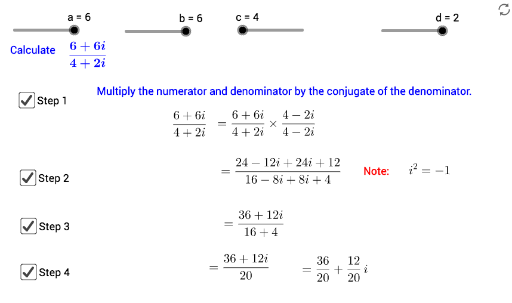
This example demonstrates the process of dividing complex numbers. Key mathematical concepts include basic operations with complex numbers. Using objects like z_1, a, b, c from the construction summary, it illustrates the geometric meaning of complex number division. Suitable for high school math education.
GeoGebra Commands & Parameters
(7 - (4 * ί)) / (2 + ί)Numeric a(6)Numeric b(6)Numeric c(4)Numeric d(2)(-d)(a * b)(a * c)(a * e)(c * c)(c * d)(d * d)(b * c)(b * d)((-b) * d)((-c) * d)f + jg + i(-j)h + qh + qf + lg + kh + q(-d)(a * b)(a * c)(c * c)(c * d)(d * d)(b * c)(b * d)((-b) * d)((-c) * d)(-d)(a * b)(a * c)(c * c)(c * d)(d * d)(b * c)(b * d)((-b) * d)((-c) * d)(-d)(a * b)(a * c)(c * c)(c * d)(d * d)(b * c)(b * d)((-b) * d)((-c) * d)(-d)(a * b)(a * c)(c * c)(c * d)(d * d)
AI Drawing Prompt Reference
Draw a complex plane illustrating the geometric meaning of complex number division. First, plot the points for the dividend 7-4i and the divisor 2+i, then their conjugates. Connect these points with dashed lines to form a parallelogram structure. Show intermediate steps: compute products of real and imaginary parts, squares, and cross terms, using different colors for positive and negative results. Finally, use an arrow to indicate the quotient, approximately 2.2-2.6i, and label its coordinates. Keep the layout clear with evenly spaced axes, emphasizing the algebraic-geometric correspondence.
The prompt above was compiled from the original drawing commands and is for reference only.