
Describing Transformations
Loading the math board and drawing, please wait…
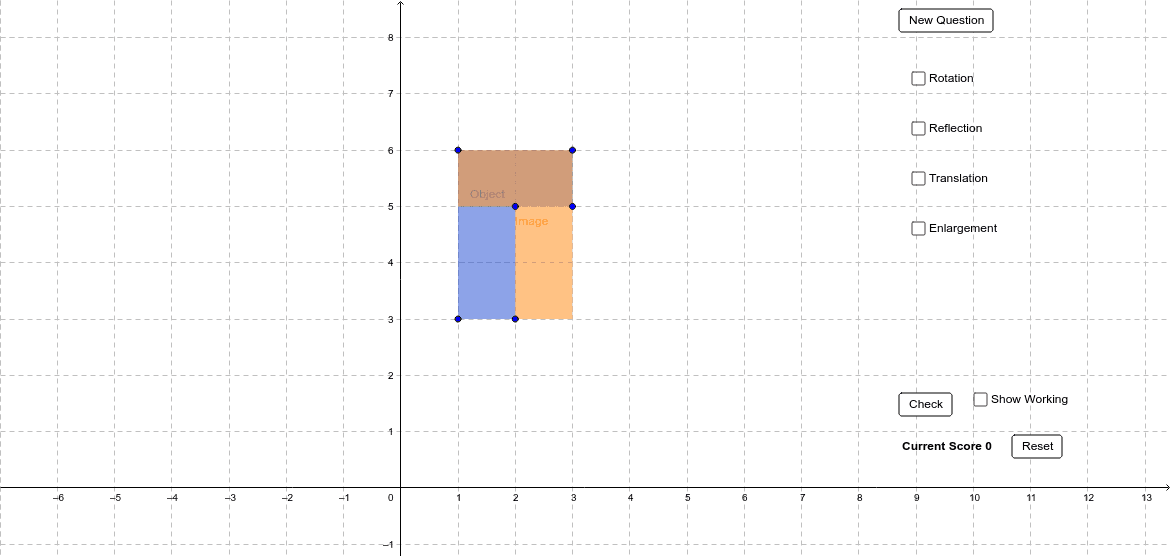
This example demonstrates the random generation and description of geometric transformations (reflection, rotation, translation) for GCSE mathematics. It involves core concepts like transformations, geometric figures, and coordinate geometry. Constructed using commands such as Random, Polygon, Textfield, and Ray to create shapes and display descriptions. Ideal for practicing and reinforcing transformation knowledge at the GCSE level.
GeoGebra Commands & Parameters
Random(0, 2) → aRandom(0, 2) → bPolygon(A, B, C, D, E, F) → Object, a_1, b_1, c, d, e, fPolygon(A_1, B_1, C_1, D_1, E_1, F_1) → RotateAnti90, a_2, b_2, c_1, d_1, e_1, f_1Polygon(A_2, B_2, C_2, D_2, E_2, F_2) → Rotate180, a_3, b_3, c_2, d_2, e_2, f_2Polygon(A_3, B_3, C_3, D_3, E_3, F_3) → RotateClock90, a_4, b_4, c_3, d_3, e_3, f_3Random(-2, 2) → x_1Random(-2, 2) → y_1Polygon(A_4, B_4, C_4, D_4, E_4, F_4) → XReflect, a_5, b_5, c_4, d_4, e_4, f_4Polygon(A_5, B_5, C_5, D_5, E_5, F_5) → YReflect, a_6, b_6, c_5, d_5, e_5, f_5Polygon(A_6, B_6, C_6, D_6, E_6, F_6) → XYReflect, a_7, b_7, c_6, d_6, e_6, f_6Random(-4, 4) → t_1Random(-4, 4) → t_2Random(2, 4) → kPolygon(A_7, B_7, C_7, D_7, E_7, F_7) → Trans, a_8, b_8, c_7, d_7, e_7, f_7Random(1, 2) → ce_xRandom(1, 2) → ce_yPolygon(A_8, B_8, C_8, D_8, E_8, F_8) → EnlargeSFk, a_9, b_9, c_8, d_8, e_8, f_8Random(1, 8) → nTextfield(ans_trx) → TranslateXTextfield(ans_try) → TranslateYTextfield(ans_rex) → ReflectXTextfield(ans_rey) → ReflectYTextfield(ans_rocx) → RotateCenterXTextfield(ans_rocy) → RotateCenterYTextfield(ans_esf) → EnlargeSFTextfield(ans_ecx) → EnlargeCXTextfield(ans_ecy) → EnlargeCYRay(CE, A) → jRay(CE, B) → lRay(CE, F) → mRay(CE, C) → pRay(CE, E) → r
AI Drawing Prompt Reference
Draw a geometric shape and generate its random reflections, rotations, and translations. Start by drawing a polygon, then rotate it 90 degrees counterclockwise, 180 degrees, and 90 degrees clockwise to show the rotation effects. Next, reflect the shape across the X-axis and Y-axis, and then reflect it across both axes to demonstrate the reflection effects. Finally, apply random translations and scaling to the shape, and mark key points with rays to visualize the entire transformation process.
The prompt above was compiled from the original drawing commands and is for reference only.