
Demonstration of Triangle's 4 Concurrency Points
Loading the math board and drawing, please wait…
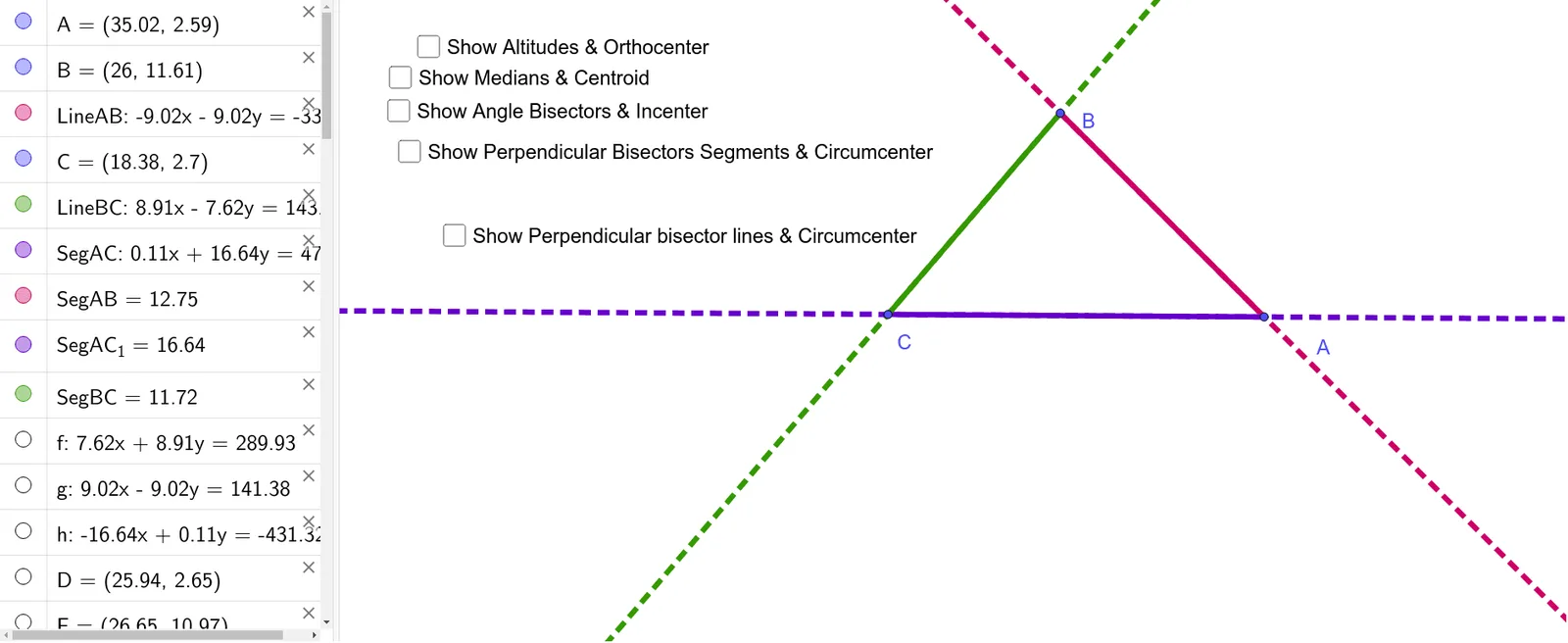
This example demonstrates the concurrency of four significant points in a triangle: centroid, orthocenter, incenter, and circumcenter. It involves core mathematical concepts such as triangle geometry, the theorem of four centers, and analytical geometry constructions. The construction highlights GeoGebra commands like Line, Segment, OrthogonalLine, Intersect, Midpoint, Angle, AngularBisector, and LineBisector, used to build triangle vertices, sides, altitudes, medians, angle bisectors, and circles. It is suitable for high school and above students to understand key geometric properties and construction techniques of triangles.
GeoGebra Commands & Parameters
Line(A, B) → LineABLine(B, C) → LineBCLine(C, A) → SegACSegment(B, A) → SegABSegment(A, C) → SegAC_1Segment(C, B) → SegBCOrthogonalLine(A, LineBC) → fOrthogonalLine(C, LineAB) → gOrthogonalLine(B, SegAC) → hIntersect(SegAC, h) → DIntersect(g, LineAB) → FIntersect(LineBC, f) → GSegment(B, D) → AltitudeBDSegment(A, G) → AltitudeAGSegment(F, C) → AltitudeFCMidpoint(B, C) → HMidpoint(B, A) → IMidpoint(A, C) → JSegment(I, C) → MedianCISegment(B, J) → MedianBJSegment(A, H) → MedianAHAngle(A, G, B) → αAngle(B, D, C) → βAngle(C, F, A) → γSegment(A, I) → AISegment(I, B) → BISegment(B, H) → BHSegment(H, C) → CHSegment(A, J) → AJSegment(J, C) → CJIntersect(MedianCI, MedianBJ) → EIntersect(AltitudeBD, AltitudeAG) → KAngularBisector(B, C, A) → iAngularBisector(C, A, B) → jAngularBisector(A, B, C) → kIntersect(j, LineBC) → LIntersect(LineAB, i) → MIntersect(k, SegAC) → PSegment(B, P) → AngBisBPSegment(C, M) → AngBisCMSegment(L, A) → AngBisALIntersect(AngBisBP, AngBisCM) → InCenterNLineBisector(SegAC_1) → lLineBisector(SegAB) → mLineBisector(SegBC) → nIntersect(LineBC, n) → NIntersect(LineAB, m) → OIntersect(SegAC, l) → QIntersect(l, m) → RSegment(R, Q) → PerpBisPQSegment(R, N) → PerpBisRNSegment(R, O) → PerpBisORAngle(R, Q, C) → δAngle(R, N, B) → εAngle(R, O, A) → ζLine(N, R) → pLine(Q, R) → qLine(R, O) → r