
Definition of Derivative - Dynamic Secant to Tangent
Loading the math board and drawing, please wait…
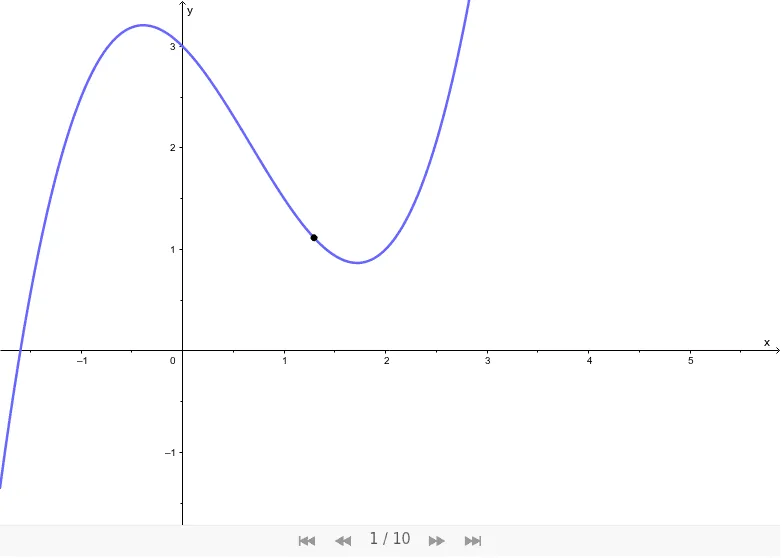
This GeoGebra example dynamically illustrates the definition of the derivative: as point B moves along the curve toward point A, the slope of the secant line AB approaches the slope of the tangent line at A, which is the derivative value. Core mathematical concepts include derivative, limit, secant and tangent lines, and coordinate changes on a function graph. Construction uses GeoGebra commands such as Point, Segment, Line, Tangent, Intersect, and Angle, with objects like function f, points A and B, secant line d, tangent line k, and related angles and text labels. The dynamic behavior is achieved by dragging point B or using a slider. Suitable for high school and introductory college calculus students to grasp the geometric meaning of the derivative, and useful for classroom demonstrations or self-study.
GeoGebra Commands & Parameters
Point(f) → ASegment(A, A_x) → gSegment(A, A_y) → iSegment(D, B) → dSegment(D, C) → eLine(A, D) → aTangent(A, f) → bIntersect(b, xAxis) → EIntersect(a, xAxis) → FAngle(D, F, A_x) → βAngle(A_x, E, D) → α
AI Drawing Prompt Reference
Draw a function graph and place a fixed point A and a movable point B on it. Connect A and B to form a secant line. As B moves closer to A, the secant line becomes the tangent line. Also, draw the tangent line at point A and mark the intersection points E and F with the x-axis for the tangent and secant lines, respectively. Finally, label the angles α formed by the tangent line and the x-axis, and β formed by the secant line and the x-axis.
The prompt above was compiled from the original drawing commands and is for reference only.