
Cube Volume Measurement and Translation Transformation Demo by tlindy
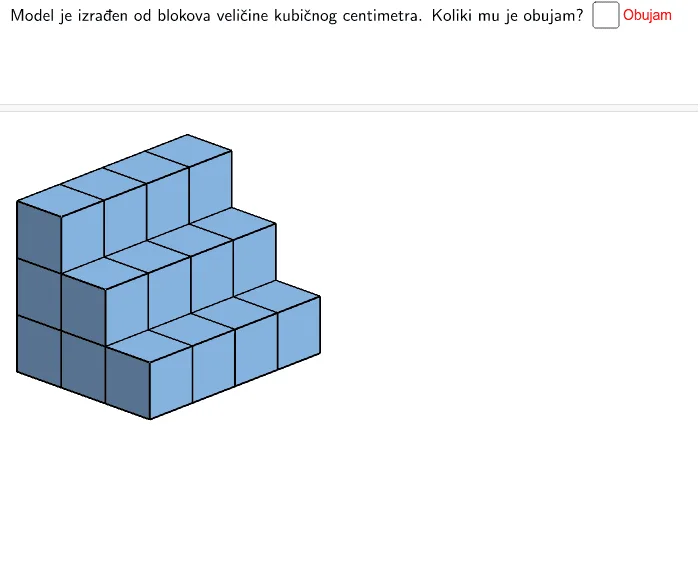
This GeoGebra example demonstrates the measurement of a cube's volume and its translation transformation in solid geometry. By constructing a cube in three-dimensional space along with its faces and edges, and applying vector translation operations, it visually presents the structural characteristics and volume calculation principles of spatial geometric figures. It is suitable for solid geometry teaching, helping students build intuitive understanding of how three-dimensional shapes behave under translation while preserving their volume.
Through interactive manipulation, users can observe how a cube moves along a chosen vector direction without any rotation or deformation. This transformation preserves all geometric properties including edge lengths, face areas, and internal angles, reinforcing the fundamental concept that translation is a rigid motion. Students can adjust the translation vector in real time, watching the cube shift smoothly across the coordinate plane while its volume remains constant throughout the movement.
The applet displays the numerical value of the cube's volume alongside the side length input, allowing learners to verify the formula V equals s cubed through direct experimentation. Educational value is enhanced by the ability to drag vertices, toggle visibility of individual faces and edges, and visualize the path traced by each vertex during translation. These interactions support multiple modes of engagement, from passive observation to active discovery.
Key mathematical concepts covered include volume formulas for cubes, the definition and properties of translation in three-dimensional space, the invariance of volume under rigid transformations, coordinate representation of vectors, and the relationship between geometric construction and algebraic computation. The applet is particularly useful in middle school and high school geometry curricula, where students first encounter spatial reasoning and solid figures. Teachers can employ this tool as a classroom demonstration or assign it as an exploratory activity for independent practice, making abstract geometric principles more concrete and accessible.
Loading the math board and drawing, please wait…