
Construction of Pascal's Triangle using Vectors and Sequences
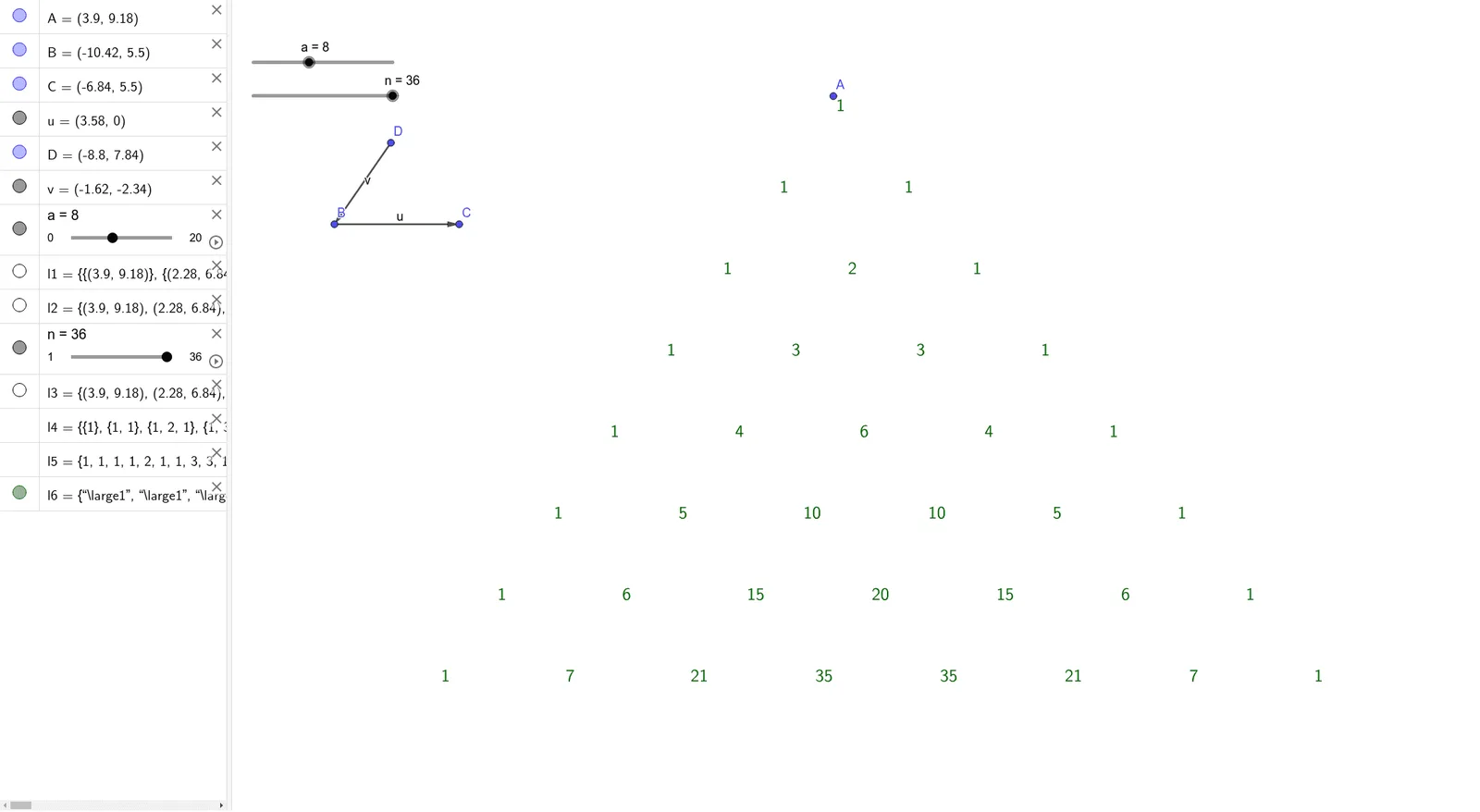
This example demonstrates how to dynamically construct Pascal's Triangle using GeoGebra commands such as Vector, Sequence, and Flatten. By defining base points and vectors, and applying sequence commands to generate the geometric arrangement of binomial coefficients, it visually illustrates the recursive relationships and symmetry of combinations, making it ideal for algebra and discrete mathematics instruction. The applet begins with a seed point and uses vector translations to position each row of the triangle on the coordinate plane. The Sequence command iteratively computes each entry by summing the two entries directly above it, faithfully reproducing the additive rule that defines Pascal's Triangle. The Flatten command is employed to collapse nested lists into a single ordered collection, enabling smooth rendering of all rows in one drawing operation. As students interact with the construction, they can dynamically adjust parameters to observe how each coefficient emerges from the row above, reinforcing the fundamental identity C(n,k) = C(n-1,k-1) + C(n-1,k). The built-in symmetry of the triangle becomes immediately apparent, as left-right mirrored entries are seen to be equal. This interactive visualization supports conceptual understanding by linking abstract combinatorial formulas to concrete geometric placement on the canvas. Instructors can use the applet to guide classroom discussions on binomial expansions, factorial-based computations, and the connection between Pascal's Triangle and the Binomial Theorem. Students benefit from an active learning experience where they can animate the construction step by step, verify computed values, and explore how increasing the number of rows reveals increasingly intricate patterns. The applet also invites further exploration, such as highlighting entries divisible by a specific integer to uncover fractal-like structures like Sierpinski's Triangle. Overall, this GeoGebra model provides a powerful, engaging tool for visualizing one of the most important constructs in discrete mathematics and combinatorics.
Loading the math board and drawing, please wait…