
Classifying Quadrilaterals
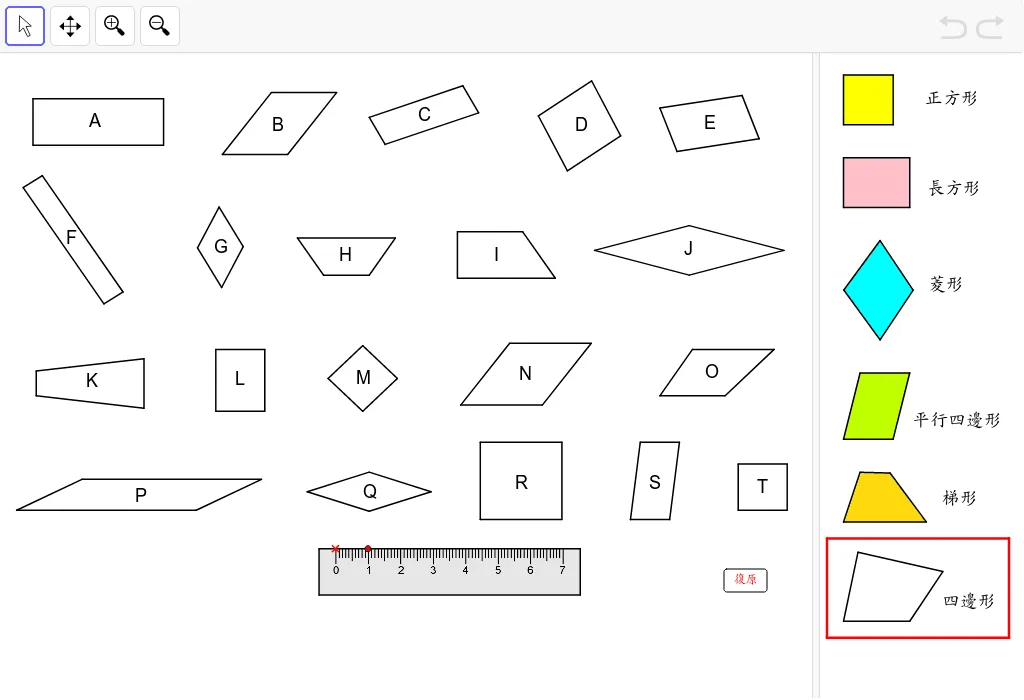
This GeoGebra applet demonstrates the classification of quadrilaterals based on their geometric properties. By using different colors to distinguish various types of quadrilaterals, such as rectangles, squares, parallelograms, trapezoids, and general quadrilaterals, it helps learners visually understand the hierarchical relationships and classification criteria among these shapes. The applet utilizes polygon and vector constructions to illustrate the fundamental characteristics and determination methods of quadrilaterals in plane geometry. Users can interactively manipulate the vertices of the quadrilateral to observe how its classification changes in real time as side lengths, angles, and parallelism conditions are altered. This dynamic exploration reinforces the concept that certain quadrilateral types are special cases within broader categories—for example, a square is both a rectangle and a rhombus, while every rectangle is a parallelogram. The color-coding system makes it immediately clear which category a shape belongs to and how subsets overlap within the classification tree. Through this hands-on, visual approach, students develop a deeper conceptual understanding of geometric definitions, the logical structure of mathematical classifications, and the distinguishing properties that define each type of quadrilateral. The applet serves as an effective teaching and learning tool for middle school and high school geometry courses, allowing learners to test conjectures, explore edge cases, and build intuition about the relationships between sides, angles, and diagonals.
In collections
Quadrilaterals (2001 Teacher Edition)
Grade 4 Semester 2: Quadrilaterals (Student Edition)
Quadrilaterals
Loading the math board and drawing, please wait…