
Circle Overlap Problem: Geometric Construction and Area Exploration of Overlappi
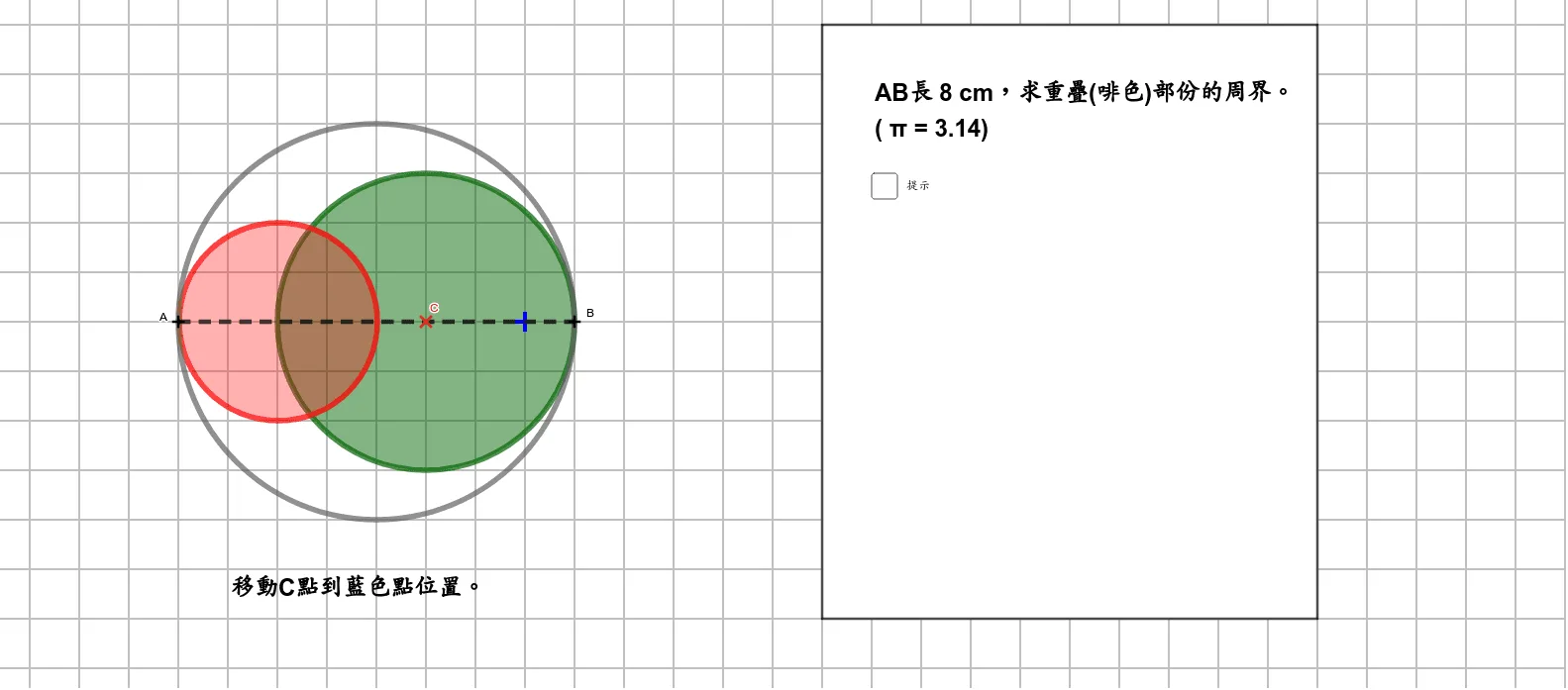
This GeoGebra example demonstrates the geometric relationships and area calculations when multiple circles overlap. By constructing fundamental geometric objects such as circles, rays, segments, intersection points, and polygons, it dynamically visualizes the formation of overlapping regions between circles. Users can observe how the shape of the overlapping area changes under different center distances and radius conditions. The applet employs definite integrals to compute the area of the intersecting region, seamlessly blending classical Euclidean geometry with calculus-based area computation. Through interactive manipulation, learners can drag circle centers, adjust radii, and watch in real time as the overlap region morphs from disjoint circles through partial intersection to complete containment. The construction guides students through identifying key geometric elements including chord lines, circular segments (lens-shaped regions), and polygonal approximations within the overlap zone. This dynamic exploration supports investigation of several important mathematical topics: the position relationships between two circles (externally separate, externally tangent, intersecting at two points, internally tangent, and one contained within the other), the calculation of circular segment and lens areas using both geometric formulas and integral methods, and the application of geometric transformations such as translation and scaling to understand how overlap properties scale with size. The integration component shows how splitting the overlapping region into circular sectors and triangles, then computing the difference, yields the exact area — reinforcing the connection between geometric decomposition and analytical calculus techniques. This applet is well suited for secondary or early undergraduate mathematics courses covering plane geometry, conic sections, and introductory integral calculus, providing an intuitive visual foundation before students engage with formal area derivations.
Loading the math board and drawing, please wait…