
Building Prisms: Dynamic Construction of Polygonal Prisms
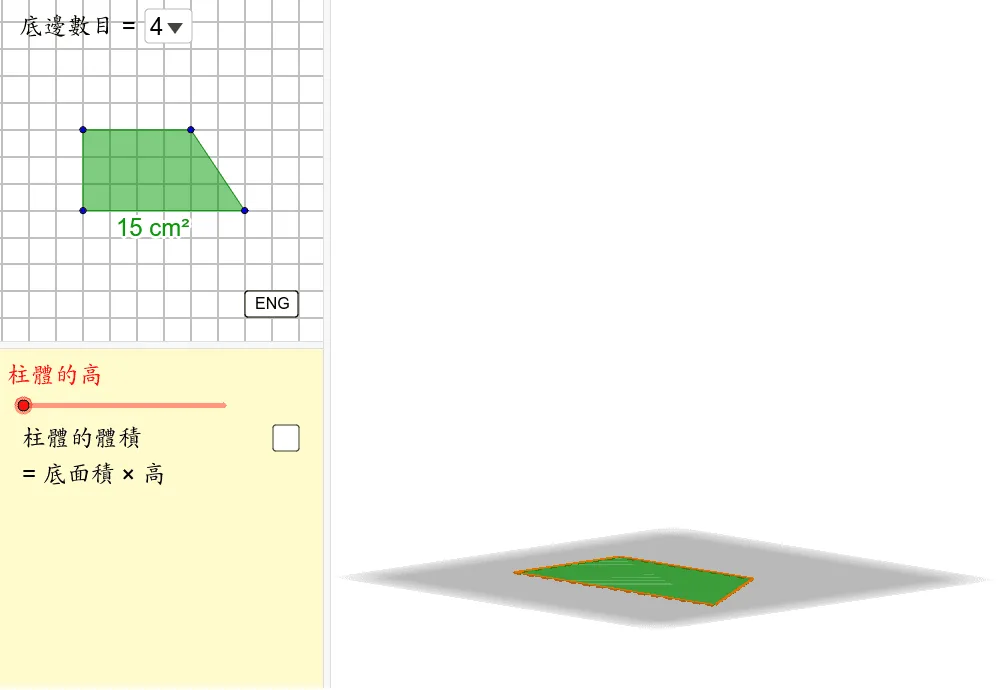
This GeoGebra example demonstrates how to construct various prisms through geometric construction and transformations. Users can adjust parameters such as the number of base polygon sides, height, rotation angle, and dilation ratio via sliders to dynamically generate prisms with different shapes, including isosceles triangular prisms, rhombic prisms, and rectangular prisms. The example integrates polygon drawing, translation, rotation, midpoint construction, and prism generation commands to visually display the structure of prism bases, lateral faces, and edges. By manipulating these interactive controls, learners can observe how changing the base polygon affects the overall form of the prism, how varying the height alters its proportions, and how rotation and scaling transform its spatial orientation. This hands-on exploration helps students develop an intuitive understanding of three-dimensional geometry, particularly the defining properties of polyhedral prisms such as congruent parallel bases, parallelogram lateral faces, and the relationship between edges and vertices. The dynamic nature of the construction allows users to experiment freely, test hypotheses, and visualize abstract geometric principles in real time, making it a valuable tool for both classroom instruction and independent study in solid geometry.
Loading the math board and drawing, please wait…