
A Geometric Construction Proof for Pythagorean Theorem
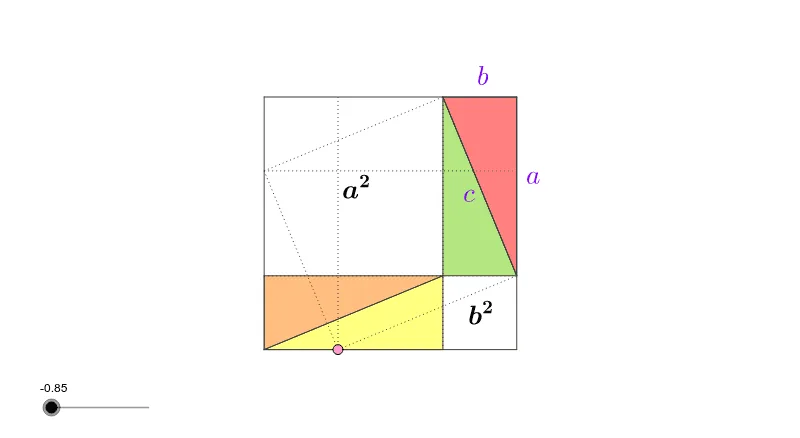
This GeoGebra example demonstrates a geometric proof of the Pythagorean theorem (Bīshī theorem) by using area decomposition and rearrangement in a right triangle. It highlights the key idea that the areas formed from the triangle and its constructed pieces lead to the equality relating the squares of the legs and the square of the hypotenuse. Core concepts include right triangles, area-based reasoning, and a construction-driven proof strategy rather than purely algebraic derivation. Construction workflow: the model uses GeoGebra commands Point, Polygon, Segment, Intersect, and Translate to build key vertices and segments, compute auxiliary intersection points, create polygonal regions (for the squares/parts), and then translate pieces to reconfigure them for area comparison. The scene includes multiple constructed points and polygon/segment objects (e.g., O, A, P; poly1; segOA; segAB; and additional helper points) to support the rearrangement argument. Suitable for middle and high school geometry lessons, classroom demonstrations, and learners aiming to understand why a² + b² = c² via visual geometric proof.
Loading the math board and drawing, please wait…