
6 Pyramid Cube Cutouts
Loading the math board and drawing, please wait…
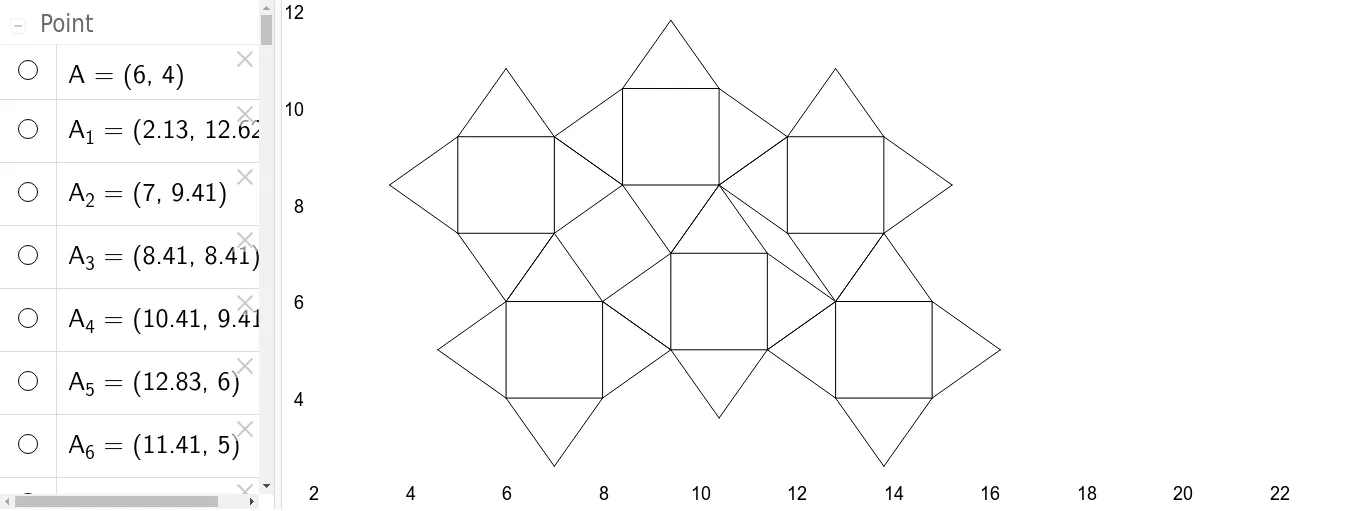
This example demonstrates a 3D geometric model of a cube with a hexagonal pyramid cut out. Key mathematical concepts include solid geometry, rotation, and volume calculation. Using GeoGebra commands such as Segment, Point, Rotate, Vector, and Translate, the model is constructed. Suitable for high school or university solid geometry courses.
GeoGebra Commands & Parameters
Segment(A, B) → aSegment(B, C) → bSegment(C, D) → cSegment(D, A) → dPoint(b) → EPoint(a) → HSegment(B, I) → eSegment(I, C) → fRotate(I, 90*°, J) → I'Rotate(I', 90*°, J) → I''Rotate(I'', 90*°, J) → I'''Segment(C, I') → gSegment(D, I') → hSegment(D, I'') → iSegment(I'', A) → jSegment(A, I''') → kSegment(I''', B) → lSegment(A_1, B_1) → a_1Segment(B_1, C_1) → b_1Segment(C_1, D_1) → c_1Segment(D_1, A_1) → d_1Point(b_1) → E_1Point(a_1) → H_1Segment(B_1, I_1) → e_1Segment(I_1, C_1) → f_1Rotate(I_1, 90*°, J_1) → I'_1Rotate(I'_1, 90*°, J_1) → I''_1Rotate(I''_1, 90*°, J_1) → I'''_1Segment(C_1, I'_1) → g_1Segment(D_1, I'_1) → h_1Segment(D_1, I''_1) → i_1Segment(I''_1, A_1) → j_1Segment(A_1, I'''_1) → k_1Segment(I'''_1, B_1) → l_1Vector(I''_1, C) → uTranslate(A_1, u) → KTranslate(B_1, u) → LSegment(K, L) → mTranslate(B_1, u) → MTranslate(C_1, u) → NSegment(M, N) → nTranslate(C_1, u) → OTranslate(D_1, u) → PSegment(O, P) → pTranslate(D_1, u) → QTranslate(A_1, u) → RSegment(Q, R) → qTranslate(B_1, u) → STranslate(I_1, u) → TSegment(S, T) → rTranslate(I_1, u) → UTranslate(C_1, u) → VSegment(U, V) → sTranslate(C_1, u) → WTranslate(I'_1, u) → ZSegment(W, Z) → tTranslate(D_1, u) → F_1Translate(I'_1, u) → G_1Segment(F_1, G_1) → m_1Translate(D_1, u) → K_1Translate(I''_1, u) → L_1Segment(K_1, L_1) → n_1Translate(I''_1, u) → M_1Translate(A_1, u) → N_1Segment(M_1, N_1) → p_1Translate(A_1, u) → O_1Translate(I'''_1, u) → P_1Segment(O_1, P_1) → q_1Translate(I'''_1, u) → Q_1Translate(B_1, u) → R_1Segment(Q_1, R_1) → r_1Translate(E_1, u) → S_1Translate(H_1, u) → T_1Translate(J_1, u) → U_1Vector(I'''_1, D) → vTranslate(A_1, v) → V_1Translate(B_1, v) → W_1Segment(V_1, W_1) → s_1Translate(B_1, v) → Z_1Translate(C_1, v) → A_2Segment(Z_1, A_2) → t_1Translate(C_1, v) → B_2Translate(D_1, v) → C_2Segment(B_2, C_2) → a_2Translate(D_1, v) → D_2Translate(A_1, v) → E_2Segment(D_2, E_2) → b_2Translate(B_1, v) → F_2Translate(I_1, v) → G_2Segment(F_2, G_2) → c_2Translate(I_1, v) → H_2Translate(C_1, v) → I_2Segment(H_2, I_2) → d_2Translate(C_1, v) → J_2Translate(I'_1, v) → K_2Segment(J_2, K_2) → e_2Translate(D_1, v) → L_2Translate(I'_1, v) → M_2Segment(L_2, M_2) → f_2Translate(D_1, v) → N_2Translate(I''_1, v) → O_2Segment(N_2, O_2) → g_2Translate(I''_1, v) → P_2Translate(A_1, v) → Q_2Segment(P_2, Q_2) → h_2Translate(A_1, v) → R_2Translate(I'''_1, v) → S_2Segment(R_2, S_2) → i_2Translate(I'''_1, v) → T_2Translate(B_1, v) → U_2Segment(T_2, U_2) → j_2Translate(E_1, v) → V_2Translate(H_1, v) → W_2Translate(J_1, v) → Z_2Vector(I'''_1, P) → wTranslate(A_1, w) → A_3Translate(B_1, w) → B_3Segment(A_3, B_3) → k_2Translate(B_1, w) → C_3Translate(C_1, w) → D_3Segment(C_3, D_3) → l_2Translate(C_1, w) → E_3Translate(D_1, w) → F_3Segment(E_3, F_3) → m_2Translate(D_1, w) → G_3Translate(A_1, w) → H_3Segment(G_3, H_3) → n_2Translate(B_1, w) → I_3Translate(I_1, w) → J_3Segment(I_3, J_3) → p_2Translate(I_1, w) → K_3Translate(C_1, w) → L_3Segment(K_3, L_3) → q_2Translate(C_1, w) → M_3Translate(I'_1, w) → N_3Segment(M_3, N_3) → r_2Translate(D_1, w) → O_3Translate(I'_1, w) → P_3Segment(O_3, P_3) → s_2Translate(D_1, w) → Q_3Translate(I''_1, w) → R_3Segment(Q_3, R_3) → t_2Translate(I''_1, w) → S_3Translate(A_1, w) → T_3Segment(S_3, T_3) → a_3Translate(A_1, w) → U_3Translate(I'''_1, w) → V_3Segment(U_3, V_3) → b_3Translate(I'''_1, w) → W_3Translate(B_1, w) → Z_3Segment(W_3, Z_3) → c_3Translate(E_1, w) → A_4Translate(H_1, w) → B_4Translate(J_1, w) → C_4Vector(I''_1, Z) → u_1Translate(A_1, u_1) → D_4Translate(B_1, u_1) → E_4Segment(D_4, E_4) → d_3Translate(B_1, u_1) → F_4Translate(C_1, u_1) → G_4Segment(F_4, G_4) → e_3Translate(C_1, u_1) → H_4Translate(D_1, u_1) → I_4Segment(H_4, I_4) → f_3Translate(D_1, u_1) → J_4Translate(A_1, u_1) → K_4Segment(J_4, K_4) → g_3Translate(B_1, u_1) → L_4Translate(I_1, u_1) → M_4Segment(L_4, M_4) → h_3Translate(I_1, u_1) → N_4Translate(C_1, u_1) → O_4Segment(N_4, O_4) → i_3Translate(C_1, u_1) → P_4Translate(I'_1, u_1) → Q_4Segment(P_4, Q_4) → j_3Translate(D_1, u_1) → R_4Translate(I'_1, u_1) → S_4Segment(R_4, S_4) → k_3Translate(D_1, u_1) → T_4Translate(I''_1, u_1) → U_4Segment(T_4, U_4) → l_3Translate(I''_1, u_1) → V_4Translate(A_1, u_1) → W_4Segment(V_4, W_4) → m_3Translate(A_1, u_1) → Z_4Translate(I'''_1, u_1) → A_5Segment(Z_4, A_5) → n_3Translate(I'''_1, u_1) → B_5Translate(B_1, u_1) → C_5Segment(B_5, C_5) → p_3Translate(E_1, u_1) → D_5Translate(H_1, u_1) → E_5Translate(J_1, u_1) → F_5Vector(I''_1, L) → v_1Translate(A_1, v_1) → G_5Translate(B_1, v_1) → H_5Segment(G_5, H_5) → q_3Translate(B_1, v_1) → I_5Translate(C_1, v_1) → J_5Segment(I_5, J_5) → r_3Translate(C_1, v_1) → K_5Translate(D_1, v_1) → L_5Segment(K_5, L_5) → s_3Translate(D_1, v_1) → M_5Translate(A_1, v_1) → N_5Segment(M_5, N_5) → t_3Translate(B_1, v_1) → O_5Translate(I_1, v_1) → P_5Segment(O_5, P_5) → a_4Translate(I_1, v_1) → Q_5Translate(C_1, v_1) → R_5Segment(Q_5, R_5) → b_4Translate(C_1, v_1) → S_5Translate(I'_1, v_1) → T_5Segment(S_5, T_5) → c_4Translate(D_1, v_1) → U_5Translate(I'_1, v_1) → V_5Segment(U_5, V_5) → d_4Translate(D_1, v_1) → W_5Translate(I''_1, v_1) → Z_5Segment(W_5, Z_5) → e_4Translate(I''_1, v_1) → A_6Translate(A_1, v_1) → B_6Segment(A_6, B_6) → f_4Translate(A_1, v_1) → C_6Translate(I'''_1, v_1) → D_6Segment(C_6, D_6) → g_4Translate(I'''_1, v_1) → E_6Translate(B_1, v_1) → F_6Segment(E_6, F_6) → h_4Translate(E_1, v_1) → G_6Translate(H_1, v_1) → H_6Translate(J_1, v_1) → I_6
AI Drawing Prompt Reference
Draw a cube and then cut out a hexagonal pyramid from it. Start by creating the six faces of the cube, then select a center point I on one face and rotate I to generate the pyramid's vertices. Connect these vertices to form the pyramid. Finally, translate the pyramid's base to align with the cube's base to create the cutting effect.
The prompt above was compiled from the original drawing commands and is for reference only.