
3D Linear Equations and Spherical Reflection Example
3D Linear Equations and Spherical Reflection Example
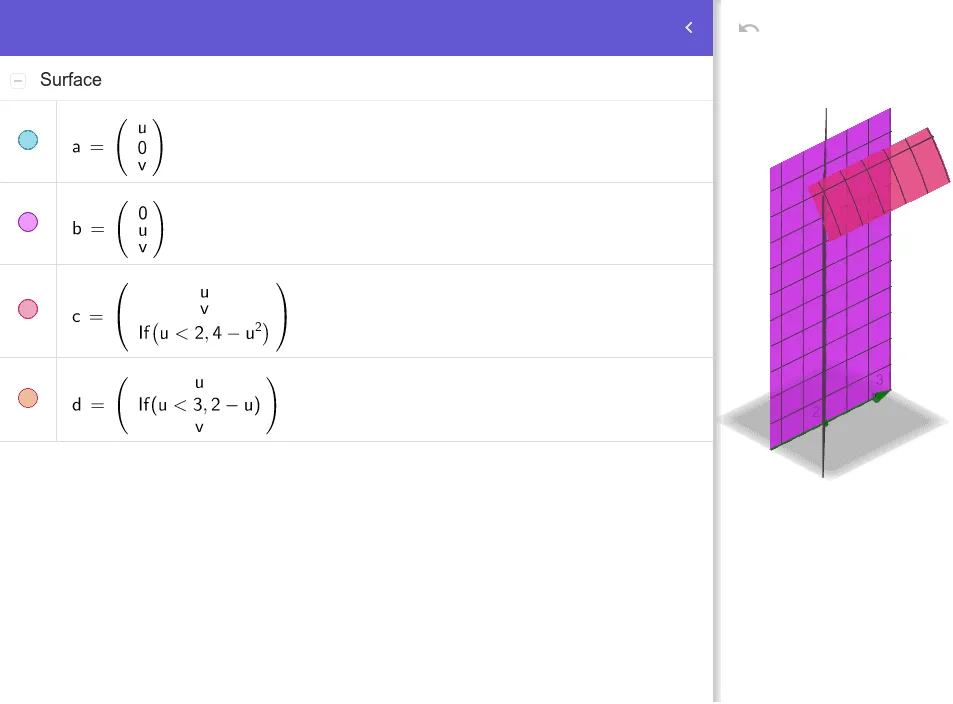
This mathematical demonstration (Section 13.2, Example 2.3) illustrates the rich interplay between geometry and algebra in three-dimensional space. Built with GeoGebra's Surface command, the applet constructs a three-dimensional sphere and explores how linear equations and spatial vectors govern its geometric properties.
The applet allows users to manipulate linear functions and vector parameters interactively, observing in real time how these algebraic objects shape and define spherical surfaces in 3D space. Students can adjust coefficients of linear equations to see their direct effect on the orientation, position, and reflection characteristics of the modeled sphere. The visualization makes abstract concepts—such as normal vectors, tangent planes, and the reflection of light or waves off a curved surface—tangible and intuitive.
Through this dynamic model, learners gain deeper insight into spatial vector operations, including dot products, cross products, and directional derivatives, all applied within the context of solid geometry. The linear equations displayed alongside the sphere demonstrate how first-degree algebraic expressions extend naturally into three dimensions, bridging the gap between elementary algebra and advanced analytic geometry.
The reflection principle shown in the applet connects to classical optics and physics: a ray striking the spherical surface follows a path determined by the local normal vector at the point of incidence. By animating these rays and tracing their reflected paths, students develop a concrete understanding of how geometric reflection laws operate on curved surfaces—a concept fundamental to fields ranging from architecture and computer graphics to physics and engineering.
Overall, this applet serves as a powerful pedagogical tool for senior high school and early undergraduate students studying multivariable calculus, analytic geometry, or vector algebra. It transforms static textbook diagrams into interactive experiments, enabling learners to explore, predict, and verify mathematical relationships through direct manipulation. The combination of algebraic precision and geometric visualization reinforces conceptual understanding and cultivates spatial reasoning skills essential for higher-level mathematics.
Loading the math board and drawing, please wait…