
Zahlenmauer:Multiplication Practice with GeoGebra
Loading the math board and drawing, please wait…
In collections
Wiederholung: Rechnen mit Dezimalzahlen und Brüchen
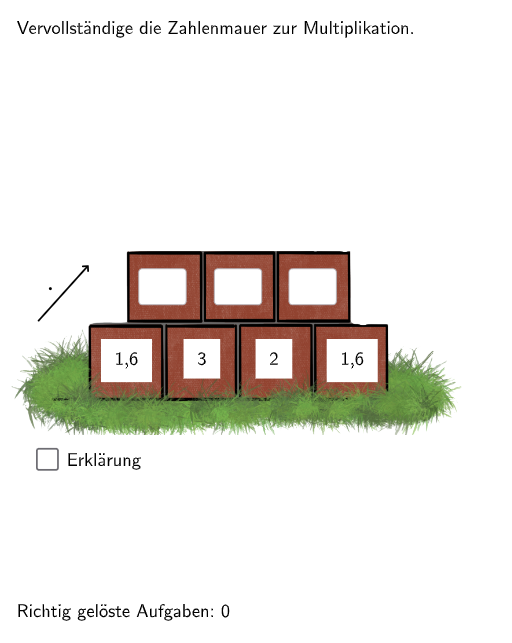
This example demonstrates creating multiplication practice problems using GeoGebra, focusing on non-negative decimal multiplication. Key mathematical concepts include multiplication rules, sequence generation, and random number application. Construction involves commands like Textfield, Sequence, Polygon, and Point to generate input boxes and random numbers, with conditional logic using If. Suitab
GeoGebra Commands & Parameters
Textfield(inputd1) → InputBoxD1Sequence(Random[1, 3], m, 1, 110) → randomNosForA2, {3, 1, 1, 2, 2, 3, 3, 1, 3, 3, 2, 2, 3, 2, 3, 2, 1, 2, 1, 3, 2, 2, 2, 2, 1, 1, 3, 3, 3, 2, 2, 1, 1, 3, 1, 1, 3, 2, 3, 2, 1, 1, 3, 3, 1, 2, 2, 1, 1, 3, 1, 3, 2, 3, 2, 1, 1, 2, 1, 2, 2, 1, 2, 3, 2, 2, 3, 1, 1, 3, 1, 3, 2, 2, 1, 2, 2, 3, 2, 1, 1, 2, 3, 3, 1, 2, 2, 3, 3, 3, 2, 2, 3, 3, 2, 2, 2, 2, 3, 2, 2, 2, 1, 3, 2, 2, 2, 2, 3, 2}Zip(RandomElement[{1, 2, 3} \ {m}], m, randomNosForA2) → randomNosForA3Textfield(inputc2) → InputBoxC2Textfield(inputc1) → InputBoxC1Textfield(inputb3) → InputBoxB3Textfield(inputb2) → InputBoxB2Textfield(inputb1) → InputBoxB1Polygon(PtopLeftCornerFeedback, PtopRightCornerFeedback, PbottomRightCornerFeedback, PbottomLeftCornerFeedback) → rectangleCorrect, rectangleCorrectS3, rectangleCorrectS4, rectangleCorrectS2, rectangleCorrectS1Shuffle(Sequence[Random[0, 10], i, 1, 100]) → randomNosForX, {6, 1, 2, 6, 9, 0, 2, 2, 9, 8, 9, 9, 2, 9, 5, 6, 1, 1, 5, 5, 10, 2, 6, 6, 6, 3, 4, 10, 3, 6, 5, 7, 10, 9, 3, 1, 3, 0, 7, 9, 6, 4, 6, 5, 7, 5, 2, 8, 1, 2, 9, 7, 6, 4, 5, 1, 9, 9, 9, 4, 1, 10, 1, 9, 1, 8, 9, 0, 6, 7, 7, 4, 3, 4, 8, 1, 9, 8, 4, 8, 8, 7, 4, 0, 8, 2, 7, 2, 5, 4, 7, 9, 0, 3, 2, 6, 2, 8, 7, 3}Element(randomNosForX, Mod[questionCount, 100] + 1) → numXShuffle(Sequence[Random[0, 10], i, 1, 100]) → randomNosForY, {9, 7, 9, 5, 7, 1, 3, 9, 7, 8, 0, 3, 3, 8, 7, 10, 9, 8, 4, 10, 9, 10, 6, 1, 6, 2, 10, 4, 1, 8, 0, 7, 2, 10, 0, 4, 3, 10, 1, 8, 9, 2, 9, 3, 4, 4, 6, 0, 3, 9, 9, 5, 3, 9, 10, 7, 9, 3, 8, 10, 4, 9, 5, 9, 1, 1, 6, 7, 10, 4, 5, 8, 6, 9, 1, 10, 5, 6, 8, 0, 0, 1, 0, 1, 6, 6, 7, 9, 5, 9, 10, 2, 8, 10, 3, 8, 8, 7, 9, 5}Element(randomNosForY, Mod[questionCount, 100] + 1) → numYAppend(true, Sequence[If[randomNosForX(i) ≟ randomNosForX(i - 1), false, true], i, 2, 100]) → stayXAppend(true, Sequence[If[randomNosForY(i) ≟ randomNosForY(i - 1), false, true], i, 2, 100]) → stayYRemove(Sequence[If[stayX(i), randomNosForX(i), 0], i, 1, 100], Sequence[0, i, 1, 100]) → randomNosForXwithoutRepeatRemove(Sequence[If[stayY(i), randomNosForY(i), 0], i, 1, 100], Sequence[0, i, 1, 100]) → randomNosForYwithoutRepeatElement(randomNosForXwithoutRepeat, Mod[questionCount, Length[randomNosForXwithoutRepeat]] + 1) → numXwithoutRepeatElement(randomNosForYwithoutRepeat, Mod[questionCount, Length[randomNosForYwithoutRepeat]] + 1) → numYwithoutRepeatPoint(Line[A, xAxis]) → BIf(correctd, 4, If[correctc, 3, If[correctb, 2, 1]]) → stepPoint(Line[C, yAxis]) → FPoint(Line[C, yAxis]) → HPoint(Line[C, yAxis]) → GSegment(L, M) → fSegment(N, O) → g