
Visual Proof of Fermat Point
Loading the math board and drawing, please wait…
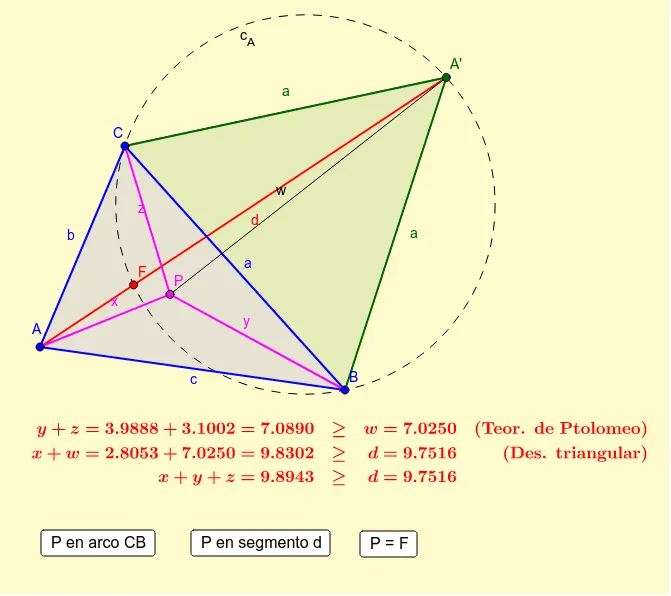
This example provides a nearly visual proof of the Fermat point minimizing the sum of distances to the vertices of a triangle using Ptolemy's theorem. It demonstrates the use of GeoGebra commands such as Polygon, Segment, Circle, and more, suitable for high school mathematics education.
GeoGebra Commands & Parameters
Polygon(C, B, 3) → polígono2, d_1, e, f, A'Segment(A, A') → dCircle(C, B, A') → c_ACenter(c_A) → DCircleArc(D, C, B) → kIntersect(k, d) → F,Polygon(A, B, C) → polígono1, c, a, bSegment(A, P) → hSegment(P, C) → iSegment(P, B) → jSegment(P, A') → wTableText({{"y + z = " + j + "+" + i + " = " + (j + i), "x + w = " + h + " + " + w + " = " + (h + w), "x + y + z = " + (h + i + j)}, {If[varc ∨ vfer, "=", "≥"], If[vseg ∨ vfer, "=", "≥"], If[vseg ∧ varc ∨ vfer, "=", "≥"]}, {"w = " + w, "d = " + d, "d = " + d}, {"(Teor. de Ptolomeo)", "(Des. triangular)", " "}}, "vr") → texto2
AI Drawing Prompt Reference
Draw a triangle ABC, then construct a point P such that the sum PA+PB+PC is minimized. Use the Fermat point concept to find this point P by constructing auxiliary circles and segments, and prove that PA+PB+PC equals the sum of certain segments of triangle ABC.
The prompt above was compiled from the original drawing commands and is for reference only.