
Unit Circle Diagram of Trigonometric Ratios
Loading the math board and drawing, please wait…
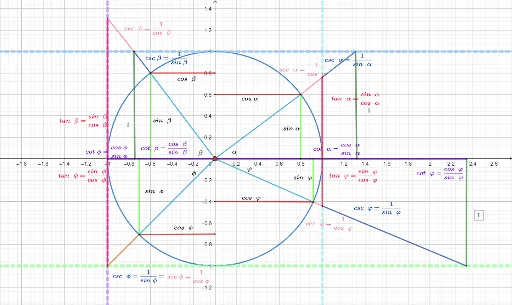
① This example demonstrates how the unit circle visually represents the trigonometric ratios (sine, cosine, tangent) through geometric segments and intersection points. ② Core mathematical concepts include the unit circle definition, trigonometric functions, right-triangle side ratios, the Pythagorean theorem, and coordinate symmetry. ③ Construction details: Using GeoGebra commands Point, Intersect, and Segment, along with multiple objects (eq1, eq2, f, g, etc.), the diagram builds the unit circle, axes, radius segments, and perpendicular lines, marking the lengths corresponding to each trigonometric function. ④ Suitable for high school or introductory college students learning trigonometry, and useful for teachers demonstrating the geometric meaning of sine, cosine, and tangent, as well as for exploring identities and symmetry on the unit circle.
GeoGebra Commands & Parameters
Point(eq1) → BIntersect(xAxis, yAxis) → APoint(eq1) → CSegment(A, C) → hPoint(eq1) → DSegment(A, D) → iPoint(eq1) → ESegment(A, E) → jPoint(eq1) → FSegment(A, F) → kIntersect(eq3, g) → GSegment(E, G) → lPoint(eq2) → HSegment(F, H) → mIntersect(eq1, h, 1) → IPoint(eq2) → JSegment(I, J) → nPoint(f) → KSegment(D, K) → pPoint(g) → LSegment(H, L) → qPoint(f) → MSegment(J, M) → rPoint(eq3) → NSegment(K, N) → sPoint(xAxis) → OSegment(L, O) → tPoint(xAxis) → PSegment(M, P) → aPoint(xAxis) → QSegment(K, Q) → bIntersect(eq1, eq3, 1) → RSegment(G, R) → cIntersect(eq1, eq2, 1) → SSegment(S, J) → dSegment(R, N) → eSegment(S, H) → f_1Segment(Q, A) → g_1Segment(A, O) → h_1Segment(Q, R) → i_1Segment(I, T) → j_1Point(g_1) → USegment(D, U) → k_1Point(g_1) → VSegment(E, V) → l_1Point(h_1) → WSegment(F, W) → m_1Point(yAxis) → ZSegment(E, Z) → n_1Point(yAxis) → A_1Segment(F, A_1) → p_1Point(yAxis) → B_1Segment(I, B_1) → q_1Point(yAxis) → C_1Segment(D, C_1) → r_1
AI Drawing Prompt Reference
Draw a unit circle centered at the origin with coordinate axes. Place several points on the circle and draw radius segments from the center to these points. From each point on the circle, drop perpendicular lines to the x-axis, marking the foot points. Also, draw a vertical tangent line outside the circle, and from the center draw segments to points on this tangent, marking intersections. Use distinct segments to represent sine, cosine, and tangent values, and mark intersections with the axes. The overall diagram shows the geometric relationships of trigonometric ratios on the unit circle, including radii, perpendiculars, and tangents.
The prompt above was compiled from the original drawing commands and is for reference only.