
Trisecting a Cube into Three Congruent Pyramids
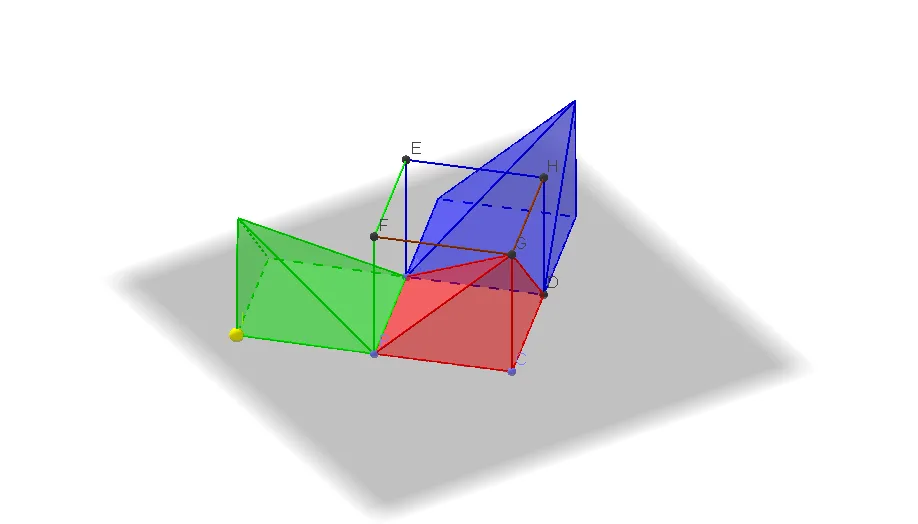
This mathematical applet demonstrates how to trisect a cube into three congruent square pyramids using GeoGebra's 3D geometric construction. The model provides an intuitive and dynamic visualization of the volumetric relationship and spatial structure between a cube and its inscribed pyramids.
Each of the three congruent pyramids shares a common vertex at one corner of the cube, while their square bases collectively cover three adjacent faces of the cube. The construction allows users to manipulate and rotate the 3D model, observing how the pyramids fit together seamlessly to reconstruct the original cube. This hands-on interaction reinforces the fundamental geometric principle that each pyramid occupies exactly one-third of the cube's volume, which directly connects to the well-known formula for the volume of a pyramid: one-third times the base area times the height.
The applet is an excellent educational tool for students studying solid geometry. It deepens understanding of volume calculations for three-dimensional figures, enhances spatial reasoning and visualization skills, and illustrates the dissection principle for polyhedra. By visually tracing the boundaries and shared edges between the pyramids, learners gain insight into how complex 3D shapes can be decomposed into simpler, congruent components. This classic example of cube partitioning serves as a foundational case for exploring geometric decomposition, symmetry, and the relationships between different polyhedral solids, making it particularly valuable for classroom instruction and self-directed exploration in geometry courses.
In collections
S3 Area and Volume
Loading the math board and drawing, please wait…