
Surface Area of a Sphere by once_a_student
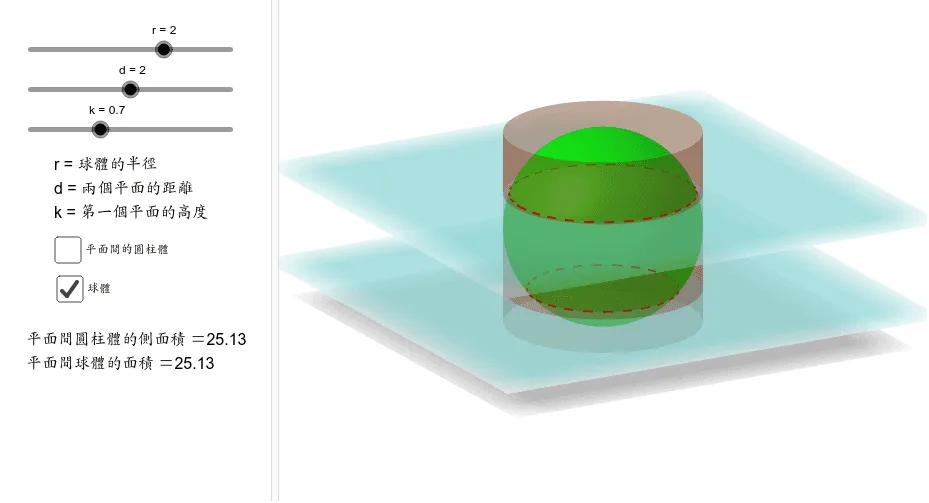
This GeoGebra example demonstrates the surface area of a sphere through interactive 3D geometric construction. Using commands such as Sphere, Cylinder, and IntersectPath, it builds a visual model that illustrates the classic relationship between a sphere's surface area and the lateral surface area of its circumscribed cylinder, known as Archimedes' theorem: the surface area of a sphere equals the lateral area of the enclosing cylinder, expressed by the formula 4πr². The construction includes multiple geometric objects and labeled annotations, such as lateral surface area labels, which help learners understand the origin and geometric meaning of the sphere surface area formula from a solid geometry perspective. Students can interact with the model to rotate, zoom, and explore the spatial relationships between the sphere and its circumscribed cylinder, gaining an intuitive grasp of why the formula takes the form 4πr². The applet is suitable for middle school and university-level mathematics instruction, serving as a powerful visual aid for teaching one of the most elegant results in classical geometry. By connecting algebraic formulas with geometric intuition, this tool supports deeper conceptual understanding and helps students appreciate the historical significance of Archimedes' discovery.
Loading the math board and drawing, please wait…