
Subtraction with Integers in a Lift: Find the Final Floor After Moves
Loading the math board and drawing, please wait…
In collections
Erstes Rechnen mit ganzen Zahlen
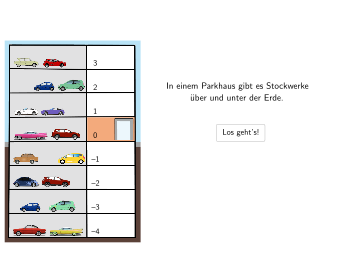
This GeoGebra lesson demonstrates an animated lift scenario where the elevator starts at a given floor and moves up or down by several floors; students then determine the final floor level. The key math ideas are integer addition and subtraction, interpreting positive/negative numbers as up/down directions, and modeling the situation with “start + displacement = end” to select or write the correct
GeoGebra Commands & Parameters
Textfield(input13) → Eingabefeld13Textfield(input11) → Eingabefeld11Point(Line[Parkhaus1, xAxis]) → Parkhaus2Sequence(P0 + (0, (m * heightstock)), m, 0, 7) → textpointsTranslate(textpoints, (widthstock, 0)) → liftpointsPoint(liftpoints) → PLift1Polygon(PLift1, PLift1 + ((-0.96 * widthlift), 0), PLift1 + ((-0.96 * widthlift), (-0.95 * heightstock)), PLift1 + (0, (-0.95 * heightstock))) → lift, plift1, f, g, hTextfield(input5) → Eingabefeld5Textfield(input8) → Eingabefeld8Textfield(input19) → Eingabefeld19Textfield(input20) → Eingabefeld20Textfield(input21) → Eingabefeld21Textfield(input22) → Eingabefeld22SelectedIndex(DropDown18) → input18SelectedIndex(DropDown17) → input17SelectedIndex(DropDown15) → input15SelectedIndex(DropDown14) → input14SelectedIndex(DropDown6) → input6SelectedIndex(DropDown3) → input3SelectedIndex(DropDown9) → input9SelectedIndex(DropDown16) → input16Element({0, 1, 2, 3, 6, 4, 5}, step) → exnumElement({1, 4, 1, 8, 5, 2, If[¬correct16, 5, 1]}, exnum + 1) → ausgangsstockIndexOf(PLift1, liftpoints) → stockindexIf(stockindex > ausgangsstock, Sequence[ausgangsstock, stockindex - 1], {}) → bogerlrunterIf(stockindex < ausgangsstock, Sequence[ausgangsstock - 1, stockindex], {}) → bogerlraufTextfield(input2) → Eingabefeld2Zip(P + (0.45, (-0.2 * heightstock)), P, Sequence[liftpoints(m), m, 1, 8]) → bogerlpointsTranslate(bogerlpoints, (0, (1 * heightstock))) → bogerlpointsuntenZip(Segment[A, B], A, bogerlpoints, B, bogerlpointsunten) → bogerlallJoin({bogerlrauf, bogerlrunter}) → bogerlnumsKeepIf(IndexOf[m, bogerlall] ∈ bogerlnums, m, bogerlall) → bogerlJoin({Sequence[Segment[Corner[4] + (RasterPixMat * ((k * RasterStepXY), 0)), Corner[4] + (RasterPixMat * ((k * RasterStepXY), RasterMaxY))], k, RasterMaxX / RasterStepXY, RasterMaxX / RasterStepXY], Sequence[Segment[Corner[4] + (RasterPixMat * (0, (k * RasterStepXY))), Corner[4] + (RasterPixMat * (RasterMaxX, (k * RasterStepXY)))], k, RasterMaxY / RasterStepXY, RasterMaxY / RasterStepXY]}) → RasterAussenElement({correct1, correct4, correct7, correct10, correct12}, exnum) → showgreenElement({4, 1, 8, 5, 5, 2, 6}, step) → endstockZip(Text[(("\textsf\small{" * m) * "}"), P + (0.4, -0.1), true, true, 0], m, {"3", "2", "1", "0", "--1", "--2", "--3", "--4"}, P, textpoints) → textlistSegment(PStart, PEndOben) → pfeilElement({correct1, correct4, correct7, correct10, correct12}, exnum) → correctStock