
Set Theory 1.4
Loading the math board and drawing, please wait…
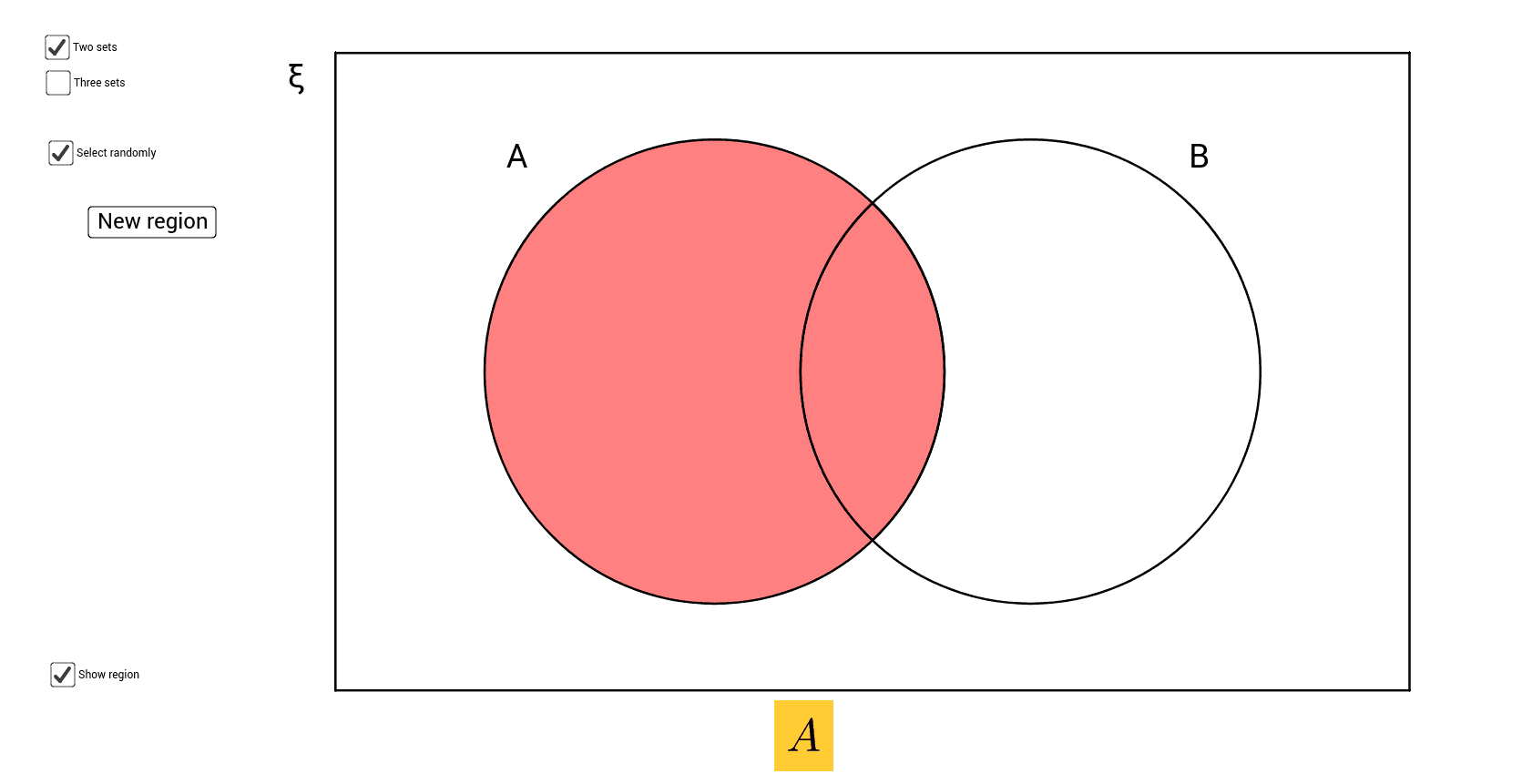
This example illustrates basic concepts of set theory. It involves mathematical concepts such as sets, natural numbers, and integers. Using GeoGebra commands like Polygon, Circle, Segment, etc., the graphical representation of sets can be constructed. Suitable for students from junior high school and above to learn basic concepts and operations of sets.
GeoGebra Commands & Parameters
Polygon(A, B, D, C) → poly1, a, b, d, cCircle(E, G) → eCircle(F, H) → fSegment(A, B) → gSegment(B, D) → hSegment(D, C) → iSegment(C, A) → jIntersect(e, f) → I, J, ,CircleArc(E, I, J) → kCircleArc(E, J, I) → pCircleArc(F, I, J) → qCircleArc(E, J, I) → tCircleArc(F, I, J) → c_1CircleArc(E, I, J) → rCircleArc(F, J, I) → d_1CircleArc(E, J, I) → e_1CircleArc(F, I, J) → f_1Polygon(A, C, D, B) → poly2, a_2, c_2, d_2, b_1Circle(E, G) → g_1Circle(F, H) → h_1Random(1, 8) → i_2Polygon(K, L, 3) → poly3, p_1, q_1, r_1, MCircle(M, m_1) → k_2Circle(K, m_1) → p_2Circle(L, m_1) → q_2Intersect(k_2, p_2, 2) → NIntersect(k_2, p_2, 1) → OIntersect(p_2, q_2, 1) → PIntersect(k_2, q_2, 2) → QIntersect(k_2, q_2, 1) → RIntersect(p_2, q_2, 2) → SCircleArc(K, O, N) → r_2CircleArc(M, N, O) → s_2CircleArc(L, R, Q) → t_2CircleArc(M, Q, R) → c_3CircleArc(L, P, S) → d_3CircleArc(K, S, P) → e_3Polygon(A, C, D, B) → poly4, a_3, c_4, d_4, b_3Circle(M, m_1) → g_3Circle(K, m_1) → h_3Circle(L, m_1) → k_3Random(1, 28) → f_3
AI Drawing Prompt Reference
Draw a basic set theory diagram with two circles and two polygons. First, draw two circles E and F. Then, draw two polygons, one with points A, C, D, B, and another with points K, L, and 3. Next, draw two arcs on circles E and F, and two more arcs on circles K, L, and M. Finally, draw arcs on circles K, L, and M to form complex intersection relationships.
The prompt above was compiled from the original drawing commands and is for reference only.