
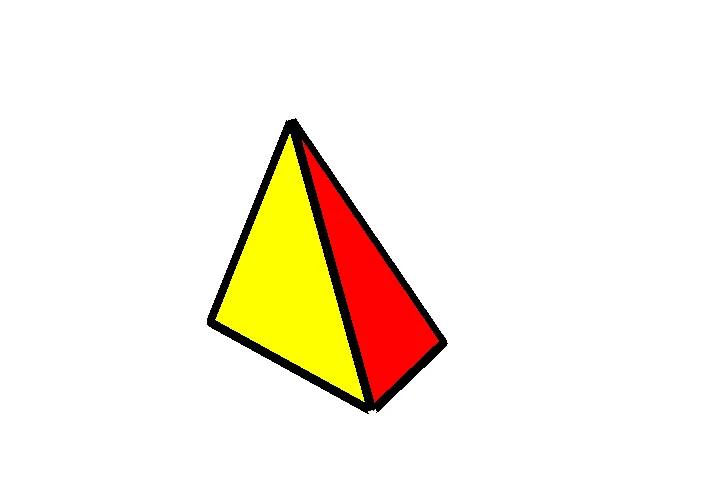
Rotation and Perspective of a Triangular Pyramid
This GeoGebra applet provides a comprehensive and interactive exploration of a triangular pyramid, also known as a tetrahedron, within a three-dimensional coordinate space. It is specifically designed to help students and educators visualize complex solid geometry concepts through dynamic construction, rotation, and perspective projection. The model is meticulously built using fundamental GeoGebra 3D commands, including Point, Polygon, and Pyramid, to create a robust solid structure. Additionally, the OrthogonalLine command is utilized to construct perpendicular elements, such as the altitude of the pyramid or the axis of rotation, which are crucial for analyzing spatial relationships and geometric properties. Users can interact with the applet by manipulating sliders that control the angle of rotation, allowing them to observe the triangular pyramid spinning around a designated axis in real time. This dynamic rotation feature is paired with perspective projection tools, enabling learners to see how the three-dimensional object is mapped onto a two-dimensional viewing plane. Students can also drag the vertices of the base polygon or the apex to alter the shape of the pyramid, instantly observing how these structural changes affect its orthogonal projections and rotational path. Through these interactive elements, the applet illuminates several key mathematical concepts. It clarifies spatial positioning, demonstrating how vertices, edges, and faces relate to one another in three dimensions. The inclusion of orthogonal lines reinforces the concept of perpendicularity in space, such as finding the shortest distance from the apex to the base plane. Furthermore, the continuous rotation and perspective shifting help demystify rotational transformations and the principles of three-dimensional to two-dimensional projection, which are often challenging to grasp from static textbook diagrams. Ultimately, this visualization tool serves as an invaluable asset for secondary and introductory college-level geometry courses. By transforming abstract theoretical concepts into tangible, manipulable models, it fosters a deeper, intuitive understanding of solid geometry. Students benefit from the ability to test hypotheses, observe geometric invariants during transformation, and develop strong spatial reasoning skills, making it an essential resource for modern mathematics education and interactive visual exploration.
Loading the math board and drawing, please wait…