
Practice with Decimal Exponent Representation
Loading the math board and drawing, please wait…
In collections
Zehnerpotenzen & Gleitkommadarstellung
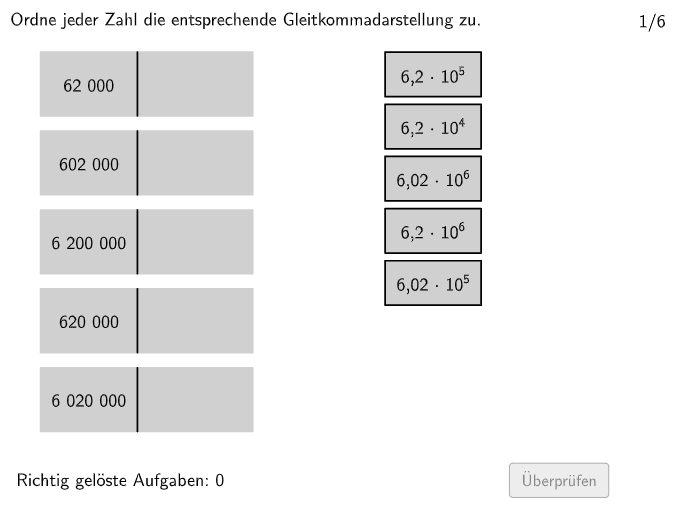
This example helps students practice using decimal exponent representation to express numbers. Key mathematical concepts include decimal exponents and floating-point representation. Using GeoGebra commands such as Polygon, Max, If, Textfield, etc., students can dynamically adjust values and observe changes. Suitable for 7-8 grade students for practice.
GeoGebra Commands & Parameters
Polygon(allowedRect4, allowedRect3, allowedRect2, allowedRect1) → allowedRect, a_1, b, c, dMax(widthsOptionsR) → widthRMax(heightsOptionsR) → heightRMax(heightR, Max[heightsOptionsL]) → heightLMax(widthsOptionsL) → widthLIf(isShuffleOptionsLechts, Shuffle[1…numOptionsR], 1…numOptionsR) → indizesOptionsRechtsIf(isShuffleOptionsLinks, Shuffle[1…numOptionsL], 1…numOptionsL) → indizesOptionsLinksTextfield(input1) → InputBox1Textfield(input2) → InputBox2Polygon(PtopLeftCornerFeedback, PtopRightCornerFeedback, PbottomRightCornerFeedback, PbottomLeftCornerFeedback) → rectangleCorrect, rectangleCorrectS3, rectangleCorrectS4, rectangleCorrectS2, rectangleCorrectS1Shuffle(Sequence[Random[0, 10], i, 1, 100]) → randomNosForX, {7, 7, 10, 5, 3, 5, 3, 6, 1, 0, 5, 6, 7, 2, 10, 10, 6, 4, 1, 2, 1, 6, 6, 0, 8, 10, 10, 1, 1, 8, 5, 8, 9, 10, 7, 0, 3, 6, 2, 10, 2, 5, 7, 6, 8, 5, 6, 3, 2, 9, 6, 4, 10, 3, 4, 1, 4, 9, 3, 2, 0, 2, 3, 1, 6, 4, 7, 2, 6, 7, 6, 5, 1, 1, 4, 7, 0, 8, 9, 8, 7, 6, 7, 8, 2, 10, 0, 7, 9, 7, 0, 1, 4, 1, 1, 7, 5, 1, 3, 4}Element(randomNosForX, Mod[questionCount, 100] + 1) → numXShuffle(Sequence[Random[0, 10], i, 1, 100]) → randomNosForY, {4, 6, 3, 9, 3, 7, 6, 10, 5, 8, 5, 4, 0, 2, 3, 10, 9, 3, 0, 4, 7, 9, 1, 1, 9, 8, 2, 2, 2, 0, 6, 3, 4, 10, 1, 4, 1, 10, 10, 9, 0, 8, 5, 10, 7, 10, 8, 6, 10, 1, 2, 7, 10, 8, 2, 4, 5, 8, 0, 6, 5, 4, 8, 9, 0, 8, 6, 0, 2, 3, 4, 8, 6, 4, 5, 4, 4, 8, 3, 0, 6, 8, 9, 3, 0, 3, 2, 2, 8, 3, 6, 2, 4, 4, 0, 6, 0, 8, 6, 7}Element(randomNosForY, Mod[questionCount, 100] + 1) → numYAppend(true, Sequence[If[randomNosForX(i) ≟ randomNosForX(i - 1), false, true], i, 2, 100]) → stayXAppend(true, Sequence[If[randomNosForY(i) ≟ randomNosForY(i - 1), false, true], i, 2, 100]) → stayYRemove(Sequence[If[stayX(i), randomNosForX(i), 0], i, 1, 100], Sequence[0, i, 1, 100]) → randomNosForXwithoutRepeatRemove(Sequence[If[stayY(i), randomNosForY(i), 0], i, 1, 100], Sequence[0, i, 1, 100]) → randomNosForYwithoutRepeatElement(randomNosForXwithoutRepeat, Mod[questionCount, Length[randomNosForXwithoutRepeat]] + 1) → numXwithoutRepeatElement(randomNosForYwithoutRepeat, Mod[questionCount, Length[randomNosForYwithoutRepeat]] + 1) → numYwithoutRepeatSequence(1) → positionsOptionsRechtsSequence(Element[optionsRAll, indizesOptionsRechts(i)], i, 1, numOptionsR) → optionsRActualLength(optionsRActual) → aSequence(Element[optionsLAll, indizesOptionsLinks(i)], i, 1, numOptionsL) → optionsLActualSequence(allOptionsL(indizesOptionsLinks(i)), i, 1, numOptionsL) → optionsLSequence(allOptionsR(indizesOptionsLinks(i)), i, 1, numOptionsL) → optionsRPolygon((-10, -2), (10, -2), (10, 10), (-10, 10)) → q1, q_1, r_1, s_1, t_1Polygon(E, F, G, H) → q2, e_1, f_2, g_2, h_2Polygon(I, J, K, L) → q3, i_2, j_2, k_1, l_1Text(optionsLActual(1), CenterOptionL1, true, true, 0, 0) → opL1Text(optionsLActual(2), CenterOptionL2, true, true, 0, 0) → opL2Text(optionsLActual(3), CenterOptionL3, true, true, 0, 0) → opL3Text(optionsLActual(4), CenterOptionL4, true, true, 0, 0) → opL4Text(optionsLActual(5), CenterOptionL5, true, true, 0, 0) → opL5PointIn(allowedRect) → CenterOptionR1Text(optionsRActual(1), CenterOptionR1, true, true, 0, 0) → opR1Polygon(CenterOptionR1, CenterOptionR1 - (widthR / 2, heightR / 2), CenterOptionR1 + (widthR / 2, ((-heightR)) / 2), CenterOptionR1 + (widthR / 2, heightR / 2), CenterOptionR1 - (widthR / 2, ((-heightR)) / 2), CenterOptionR1 - (widthR / 2, heightR / 2)) → rectRMove1, centeroptionr1, f, g, h, i, jPointIn(allowedRect) → CenterOptionR2Text(optionsRActual(2), CenterOptionR2, true, true, 0, 0) → opR2Polygon(CenterOptionR2, CenterOptionR2 - (widthR / 2, heightR / 2), CenterOptionR2 + (widthR / 2, ((-heightR)) / 2), CenterOptionR2 + (widthR / 2, heightR / 2), CenterOptionR2 - (widthR / 2, ((-heightR)) / 2), CenterOptionR2 - (widthR / 2, heightR / 2)) → rectRMove2, centeroptionr2, k, l, m, n, pPointIn(allowedRect) → CenterOptionR3Text(optionsRActual(3), CenterOptionR3, true, true, 0, 0) → opR3Polygon(CenterOptionR3, CenterOptionR3 - (widthR / 2, heightR / 2), CenterOptionR3 + (widthR / 2, ((-heightR)) / 2), CenterOptionR3 + (widthR / 2, heightR / 2), CenterOptionR3 - (widthR / 2, ((-heightR)) / 2), CenterOptionR3 - (widthR / 2, heightR / 2)) → rectRMove3, centeroptionr3, q, r, s, t, ePointIn(allowedRect) → CenterOptionR4Text(optionsRActual(4), CenterOptionR4, true, true, 0, 0) → opR4Polygon(CenterOptionR4, CenterOptionR4 - (widthR / 2, heightR / 2), CenterOptionR4 + (widthR / 2, ((-heightR)) / 2), CenterOptionR4 + (widthR / 2, heightR / 2), CenterOptionR4 - (widthR / 2, ((-heightR)) / 2), CenterOptionR4 - (widthR / 2, heightR / 2)) → rectRMove4, centeroptionr4, f_1, g_1, h_1, i_1, j_1PointIn(allowedRect) → CenterOptionR5Text(optionsRActual(5), CenterOptionR5, true, true, 0, 0) → opR5Polygon(CenterOptionR5, CenterOptionR5 - (widthR / 2, heightR / 2), CenterOptionR5 + (widthR / 2, ((-heightR)) / 2), CenterOptionR5 + (widthR / 2, heightR / 2), CenterOptionR5 - (widthR / 2, ((-heightR)) / 2), CenterOptionR5 - (widthR / 2, heightR / 2)) → rectRMove5, centeroptionr5, m_1, n_1, b_1, c_1, d_1If(CountIf[P ∈ answerRectLarger1(1), P, verticesR1] ≟ 4, 1, -1, CountIf[P ∈ answerRectLarger2(1), P, verticesR1] ≟ 4, 2, CountIf[P ∈ answerRectLarger3(1), P, verticesR1] ≟ 4, 3, CountIf[P ∈ answerRectLarger4(1), P, verticesR1] ≟ 4, 4, CountIf[P ∈ answerRectLarger5(1), P, verticesR1] ≟ 4, 5) → indexAnswerR1If(CountIf[P ∈ answerRectLarger1(1), P, verticesR2] ≟ 4, 1, -1, CountIf[P ∈ answerRectLarger2(1), P, verticesR2] ≟ 4, 2, CountIf[P ∈ answerRectLarger3(1), P, verticesR2] ≟ 4, 3, CountIf[P ∈ answerRectLarger4(1), P, verticesR2] ≟ 4, 4, CountIf[P ∈ answerRectLarger5(1), P, verticesR2] ≟ 4, 5) → indexAnswerR2If(CountIf[P ∈ answerRectLarger1(1), P, verticesR3] ≟ 4, 1, -1, CountIf[P ∈ answerRectLarger2(1), P, verticesR3] ≟ 4, 2, CountIf[P ∈ answerRectLarger3(1), P, verticesR3] ≟ 4, 3, CountIf[P ∈ answerRectLarger4(1), P, verticesR3] ≟ 4, 4, CountIf[P ∈ answerRectLarger5(1), P, verticesR3] ≟ 4, 5) → indexAnswerR3If(CountIf[P ∈ answerRectLarger1(1), P, verticesR4] ≟ 4, 1, -1, CountIf[P ∈ answerRectLarger2(1), P, verticesR4] ≟ 4, 2, CountIf[P ∈ answerRectLarger3(1), P, verticesR4] ≟ 4, 3, CountIf[P ∈ answerRectLarger4(1), P, verticesR4] ≟ 4, 4, CountIf[P ∈ answerRectLarger5(1), P, verticesR4] ≟ 4, 5) → indexAnswerR4If(CountIf[P ∈ answerRectLarger1(1), P, verticesR5] ≟ 4, 1, -1, CountIf[P ∈ answerRectLarger2(1), P, verticesR5] ≟ 4, 2, CountIf[P ∈ answerRectLarger3(1), P, verticesR5] ≟ 4, 3, CountIf[P ∈ answerRectLarger4(1), P, verticesR5] ≟ 4, 4, CountIf[P ∈ answerRectLarger5(1), P, verticesR5] ≟ 4, 5) → indexAnswerR5CountIf(ind ≠ -1, ind, indizesAnswerR) → numAnswersDraggedToLeftIf(correct, "\vphantom{✘}✓ Richtig", If[correctpartially, "\vphantom{✓}✘ Teilweise richtig", "\vphantom{✓}✘ Falsch"]) → correctTextTempText((("\Large\textsf{" * correctTextTemp) * "}"), PStartCorrectText, true, true, 1, 0) → correctText