
Polygon Area Thinking Question (1)
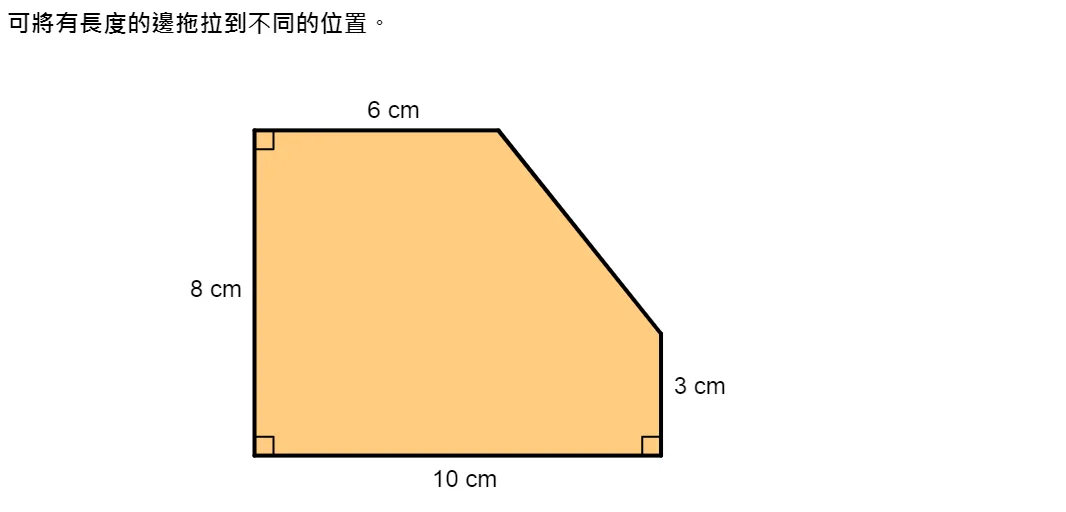
This GeoGebra applet presents a geometry thinking problem centered on polygon and triangle area relationships. The construction begins with a carefully designed polygon, from which multiple intersection points are derived through the intersection of diagonals, extended sides, or auxiliary lines. These intersections serve as the foundation for exploring deeper geometric properties.
The applet utilizes line segments, vectors, and angular measurements as analytical tools. By displaying vector arrows and angle values dynamically, it allows users to observe how changes in the polygon's shape affect internal geometric relationships. The construction emphasizes the discovery of similar triangles within the figure — identifying corresponding angles, proportional side ratios, and the conditions under which triangle similarity holds.
Area calculation is a core component. The polygon is subdivided into triangular regions through the intersection points, and the applet computes and displays the area of each triangle in real time. Users can drag vertices or adjust parameters to see how area values change while maintaining or breaking geometric relationships. This dynamic visualization reinforces the understanding that the total area of a polygon equals the sum of its component triangular areas, regardless of how the partition is constructed.
Conditional logic is integrated to create an interactive learning experience. Certain geometric properties are only displayed or activated when specific conditions are met — for example, when two triangles are proven similar, their area ratio is automatically shown alongside the square of their side ratio. When congruence conditions are satisfied, visual markers such as highlighted regions or annotations appear. This conditional feedback helps students develop reasoning skills by connecting hypotheses to observable outcomes.
The applet is designed for middle school mathematics instruction, supporting lessons on polygon area decomposition, triangle similarity criteria, and geometric proof construction. Students can manipulate the figure interactively, test conjectures, and build intuitive understanding before moving to formal written proofs. The dynamic nature of the construction encourages exploration-based learning, allowing learners to discover mathematical relationships through direct interaction rather than passive observation.
Loading the math board and drawing, please wait…