
Net Loss Probability Grid and Random Walk Model
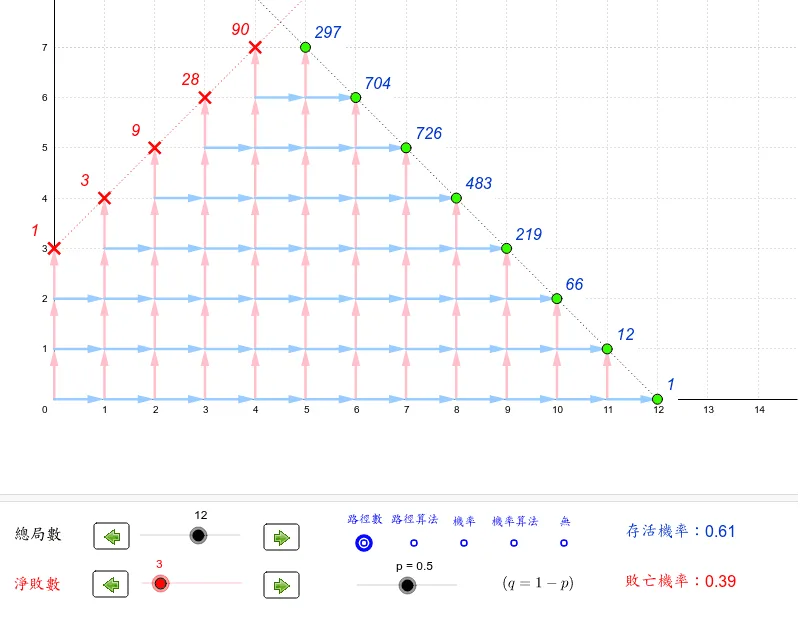
This applet demonstrates probability theory and random walk phenomena on a two-dimensional grid. In the grid, a move to the right represents a win and a move upward represents a loss, so the vertical position at any point corresponds to the net number of losses after wins and losses offset each other. This geometric setup provides an intuitive visual framework for understanding stochastic processes and absorption boundary conditions.
The model serves two main applications. First, it illustrates the classic drunkard walking problem with a one-sided absorbing cliff: if the walker reaches a certain number of net losses, they fall off the grid and the walk terminates, creating an absorbing barrier. Second, it applies to head-to-head game scenarios where one player is eliminated once they accumulate a preset threshold of net losses, turning the probability of elimination into a tractable geometric question.
Students interact with the applet by tracing dynamic random paths across the grid. Each step corresponds to a single game outcome, and the path evolves in real time to show how cumulative wins and losses accumulate. The applet also displays combinatorial statistics, counting how many distinct paths lead to each grid point and what probabilities those counts imply. This bridges the gap between abstract combinatorics and concrete stochastic visualization.
Through this interactive environment, learners develop a deeper understanding of state transitions in two-dimensional stochastic processes, how absorbing boundaries shape probability distributions, and how simple step-by-step rules generate complex outcome patterns. The visual and dynamic nature of the applet makes it particularly valuable for students encountering random walks and gambling ruin problems for the first time, as it transforms abstract formulas into observable, traceable motion on the grid.
Loading the math board and drawing, please wait…