
Maximum Projection Length of Vector OP
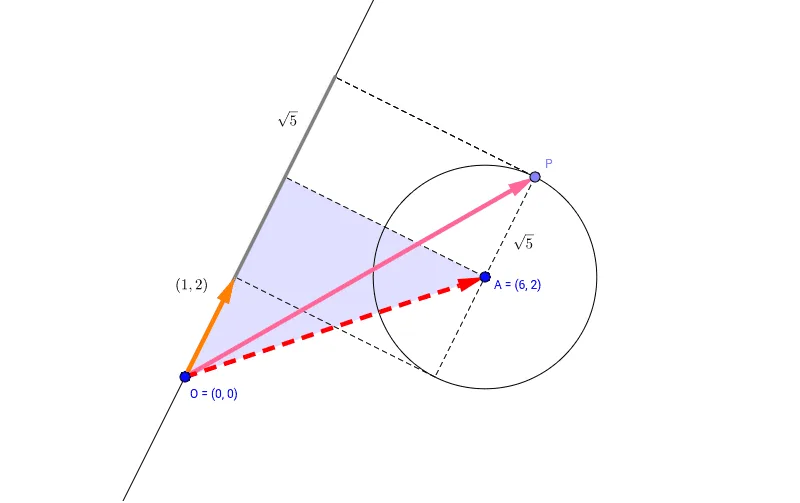
This GeoGebra applet presents a dynamic and interactive exploration of a classic geometric optimization problem: determining the maximum projection length of a vector OP. Designed specifically for advanced high school mathematics, the application bridges the gap between abstract vector algebra and concrete three-dimensional solid geometry. Users are introduced to a spatial configuration involving fixed and variable points, notably points O and P, alongside constructed geometric objects such as an isosceles triangle and a sphere.
Through the intuitive GeoGebra 3D interface, students can actively manipulate the environment to understand the problem constraints. By dragging point P along the surface of the sphere or adjusting the vertices of the isosceles triangle, learners can observe in real time how the vector OP changes in both magnitude and direction. The applet dynamically calculates and displays the projection of segment OP onto a specified target direction or a designated reference plane. As users rotate the three-dimensional view and alter the positions of the geometric elements, they can visually track the fluctuating projection length, making it easier to identify the precise spatial configuration that yields the maximum value.
Mathematically, this applet serves as a comprehensive review of several critical concepts. It relies heavily on the principles of vector projection, utilizing the dot product to compute the scalar projection of one vector onto another. Furthermore, it integrates solid geometry by imposing spatial constraints, such as restricting point P to the surface of a sphere or within the boundaries of a specific polygonal face. Solving for the maximum projection length requires students to synthesize these ideas, applying optimization techniques and spatial reasoning to find the extrema under given geometric conditions.
For students, the primary benefit of this interactive model is the visualization of otherwise highly abstract mathematical relationships. High school exams frequently feature complex vector and solid geometry problems that are difficult to sketch accurately on paper. This applet removes the cognitive load of manual 3D drawing, allowing students to focus purely on the underlying mathematical logic and problem-solving strategies. By experimenting with the model, students develop a deeper geometric intuition, learn to translate visual constraints into algebraic equations, and build the confidence needed to tackle rigorous, multi-step optimization problems in their coursework and standardized tests.
In collections
不等式
Loading the math board and drawing, please wait…