
Leonardo's Ellipsograph: Geometric Construction and Locus
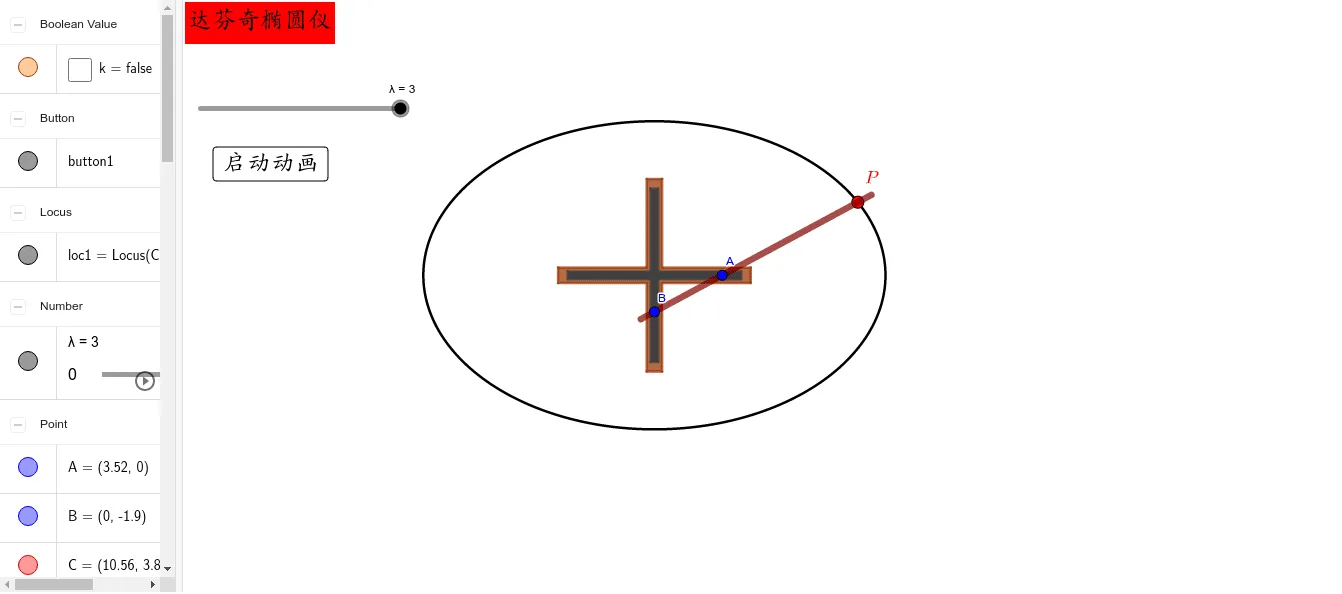
This applet demonstrates the geometric construction and working principle of Leonardo's ellipsograph, also known as the Trammel of Archimedes. The model provides an interactive visualization of how an ellipse can be constructed using simple mechanical components: two mutually perpendicular slots and a rigid rod of fixed length. Students can manipulate sliders to control the position of specific points along a line segment, and the applet uses the Locus command to trace out the resulting elliptical path in real time.
The construction illustrates a fundamental principle in geometry: a point on a line segment whose endpoints slide along two perpendicular lines will always trace an ellipse. This classic mechanism was famously studied by Leonardo da Vinci, who recognized its utility in drawing ellipses with precision using basic tools. The applet allows learners to explore how changing the position of the tracing point along the rod alters the shape of the resulting ellipse, directly connecting the physical parameters of the device to the semi-major and semi-minor axes of the curve.
This interactive model integrates several important mathematical concepts, including analytic geometry, locus generation, and polygon construction. By observing the dynamic relationship between the moving parts and the traced curve, students gain intuitive understanding of elliptical properties and the parametric equations that describe them. The applet serves as an excellent bridge between geometric intuition and algebraic representation, making it a valuable classroom tool for introducing conic sections. Through hands-on interaction, learners can discover how the constraints imposed by the perpendicular guides naturally give rise to the ellipse, reinforcing key ideas about the geometry of conic curves in an engaging and accessible way.
Loading the math board and drawing, please wait…