
Introduction to Polar and Cartesian Coordinates
This GeoGebra applet introduces the polar coordinate system and compares it with Cartesian (rectangular) coordinates. It serves as an interactive visual aid for students learning coordinate geometry and the relationships between different coordinate representations of points in the plane.
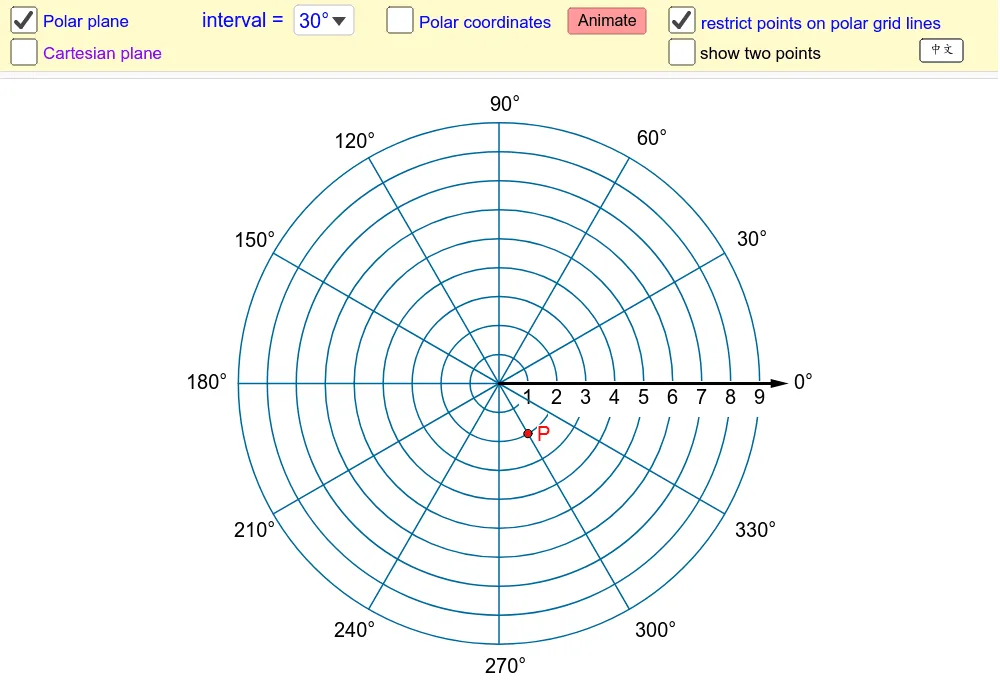
The applet allows users to interactively manipulate points and observe how they are represented in both polar and Cartesian systems simultaneously. As users move a point or adjust parameters, they can see how the polar radius (r) and polar angle (theta) relate to the x and y Cartesian components. The dynamic visualization makes it easy to understand how a single point can be described using two fundamentally different coordinate frameworks.
Geometric elements such as circular arcs, line segments, and vectors are used throughout the applet to illustrate the structure of polar coordinates and their connection to the Cartesian grid. These visual elements help learners see how the radial distance extends from the origin, how the polar angle is measured from the positive x-axis, and how the point projects onto the x and y axes to yield its Cartesian coordinates.
The applet also highlights quadrant characteristics, showing how angles and signs of coordinates change as points move across different quadrants. This provides a clear visual understanding of how polar angles sweep through the plane and how this corresponds to the sign patterns of x and y values in each quadrant.
Students benefit from this tool by developing an intuitive grasp of coordinate conversions, reinforcing their understanding of trigonometric relationships, and building spatial reasoning skills essential for topics such as parametric equations, complex numbers, and calculus applications involving polar curves. The interactive nature of the applet encourages exploration and discovery, allowing learners to test hypotheses and observe patterns in real time. This hands-on experience deepens conceptual understanding beyond what static diagrams or textbook explanations alone can provide.
In collections
Coordinate Geometry (Secondary 1)
Loading the math board and drawing, please wait…