
Hand-in-Hand Congruence Model in Regular N-gons
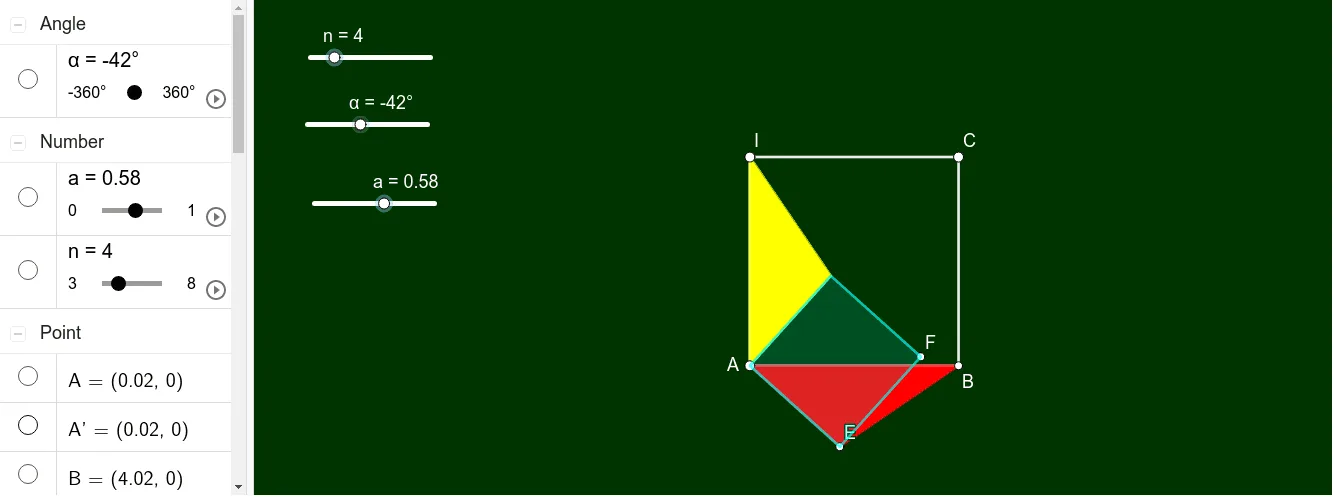
This GeoGebra applet demonstrates the hand-in-hand congruence model within regular N-sided polygons. It constructs two regular polygons that share a common vertex, creating what is known in Chinese geometry education as the hand-in-hand configuration. By employing the Polygon and Rotate commands, the applet dynamically illustrates how two triangles formed from corresponding vertices of the two regular polygons remain congruent throughout the rotational process. This classic construction serves as a powerful visual aid for understanding some of the most important concepts in plane geometry.
When two regular polygons share a single vertex, the rotational symmetry inherent in each polygon guarantees that specific pairs of triangles are always congruent, regardless of how the configuration is rotated. The applet allows users to manipulate the number of sides of the polygons and observe in real time how the congruent triangle pairs persist through continuous rotation. This dynamic behavior provides students with an intuitive grasp of rotational invariance and the deep symmetry properties that characterize regular polygons.
The hand-in-hand congruence model is one of the most frequently encountered constructions in middle school geometry competitions and classroom instruction. It connects several key topics including rotational transformations, SAS and SSS congruence criteria, properties of regular polygons, and angle chasing techniques. By interacting with this applet, students can explore these relationships visually before formalizing them through rigorous geometric proofs.
The interactive nature of the applet supports inquiry-based learning, allowing learners to test conjectures, identify patterns, and develop geometric intuition. Educators can use it as a teaching tool during lessons on triangle congruence and rotational symmetry, or as a self-exploration resource for students preparing for math competitions. The ability to adjust parameters and immediately see the consequences of those changes makes abstract geometric principles concrete and accessible, bridging the gap between visual understanding and formal deductive reasoning in geometry.
In collections
Minority Pi: Interactive Math Applets
Loading the math board and drawing, please wait…