
Geometric Construction of the Butterfly Theorem
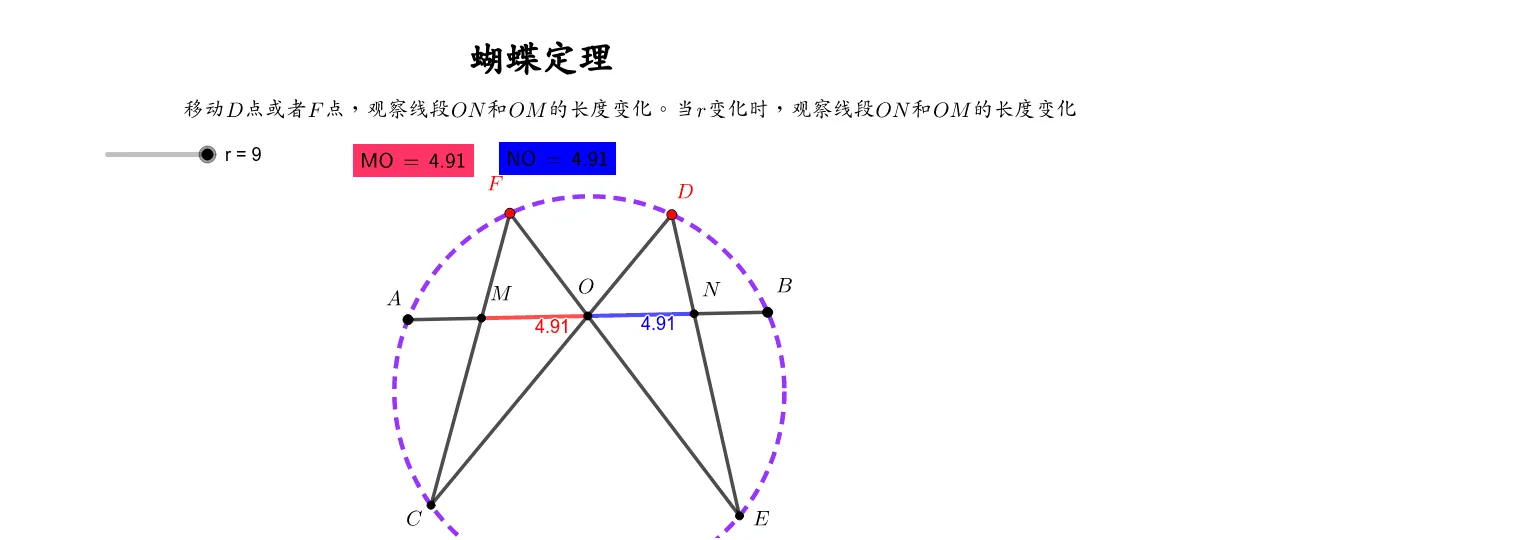
This applet demonstrates the classic Butterfly Theorem, a celebrated result in Euclidean geometry. Using GeoGebra, it constructs a circle with a chord AB and its midpoint M. Through M, two arbitrary chords CD and EF are drawn. The lines CF and ED are constructed, and their intersection points with chord AB are labeled P and Q respectively. The theorem asserts that P and Q are equidistant from M, meaning MP equals MQ, producing the characteristic butterfly-shaped figure at the heart of the construction.
Students interact with the applet by dragging the endpoints of the chords and observing how the configuration dynamically changes while maintaining the equidistance property. This interactive manipulation reinforces the invariance of the result under continuous deformation of the geometric configuration.
The construction covers fundamental geometric objects: circles, line segments, midpoints, intersection points, and connecting lines. It provides a vivid visual proof that complements traditional written demonstrations found in geometry textbooks. By making the butterfly figure explicit, the applet helps learners recognize the symmetry underlying the theorem and understand why the midpoint property holds regardless of how the two interior chords are positioned.
Educational benefits include: developing spatial reasoning skills, connecting algebraic equality to geometric symmetry, building intuition for proof strategies involving congruent triangles and cyclic quadrilaterals, and preparing students for more advanced topics in circle geometry such as power of a point and harmonic divisions. The dynamic visualization also encourages conjecture formation and self-directed exploration, making it a valuable tool for both classroom instruction and independent study.
In collections
Lumei Junior High Geometry Models
Loading the math board and drawing, please wait…