
General's Horse Drinking: Minimizing Segment Sum via Reflection
This applet demonstrates the classic General's Horse Drinking optimization problem in geometry. Given two points A and B positioned on the same side of a straight line, the goal is to find the optimal location of a point P on the line such that the sum of distances PA plus PB is minimized.
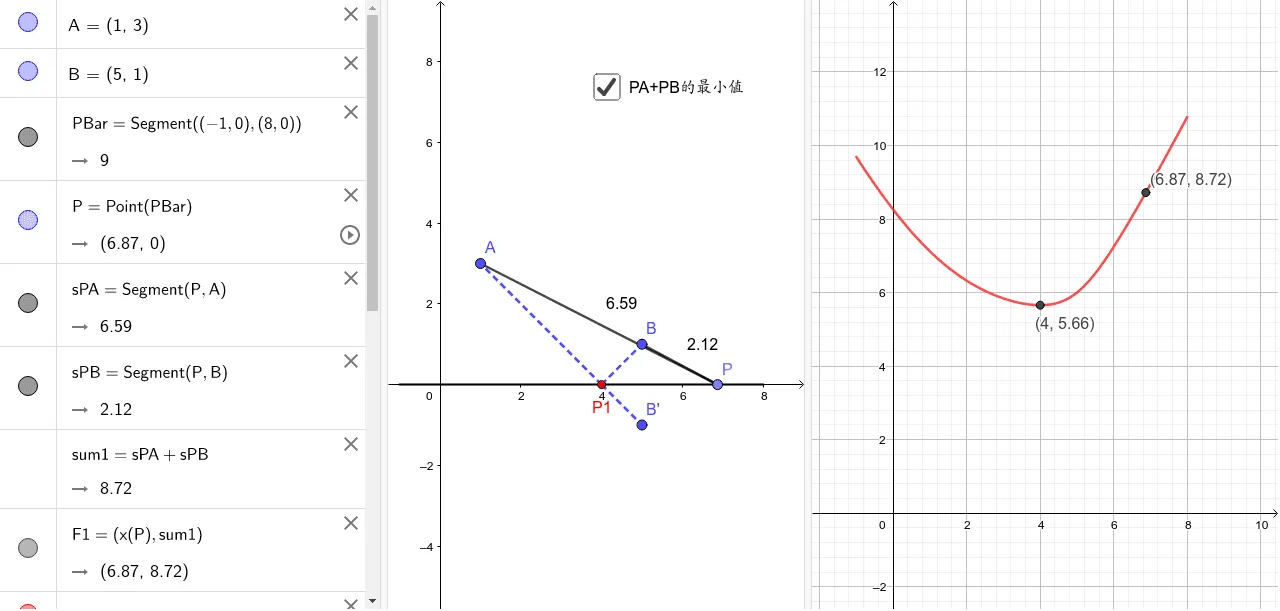
The construction proceeds through a reflection transformation. The applet first generates B prime, the symmetric image of point B across the given line, using the principle of axial symmetry. Because reflection preserves distances, the distance PB equals the distance PB prime for any point P lying on the line. Consequently, minimizing PA plus PB becomes equivalent to minimizing PA plus PB prime. The shortest path between two points is a straight line, so the minimum occurs when A, P, and B prime are collinear. Therefore, the intersection of segment AB prime with the line yields the unique optimal point P.
The applet allows users to dynamically drag point P along the line and observe in real time how the sum PA plus PB changes. As P moves away from the optimal position, the sum increases, visually confirming that the minimum is achieved exactly when P lies at the intersection of AB prime and the line. Users can also manipulate the positions of points A and B and adjust the line itself, exploring how the solution adapts under different configurations while the underlying principle remains consistent.
This interactive model integrates two fundamental mathematical concepts: axial symmetry transformations and geometric optimization. It provides students with a concrete, visual proof of the shortest path principle, reinforcing the connection between algebraic reasoning and geometric intuition. By engaging with the dynamic visualization, learners develop a deeper understanding of why reflection is the key technique for solving minimization problems involving sums of distances to a line. The applet is particularly valuable for students studying Euclidean geometry, optimization, and transformational methods, offering an intuitive foundation for more advanced topics in mathematical problem solving.
In collections
My First GeoGebra Interactive Book
Loading the math board and drawing, please wait…