
Gegenzahl: Fraction Input and Number Line Representation
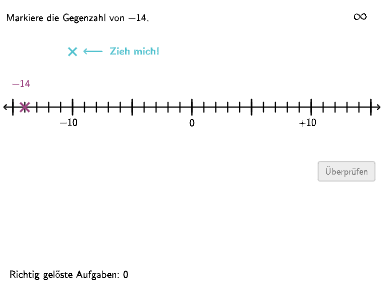
Loading the math board and drawing, please wait…
In collections
Gegenzahl und Betrag einer rationalen Zahl
The Gegenzahl example demonstrates converting fractions to positions on a number line. Key math concepts include absolute value, number line representation, and fraction conversion. Construction involves using Textfield for input, Polygon for drawing the number line, Shuffle for random point arrangement, Distance for measuring distances, and Circle for drawing circles. Suitable for middle school s
GeoGebra Commands & Parameters
Textfield(input1) → InputBox1Textfield(input2) → InputBox2Polygon(PtopLeftCornerFeedback, PtopRightCornerFeedback, PbottomRightCornerFeedback, PbottomLeftCornerFeedback) → rectangleCorrect, rectangleCorrectS3, rectangleCorrectS4, rectangleCorrectS2, rectangleCorrectS1Shuffle(Sequence[Random[0, 10], i, 1, 100]) → randomNosForX, {6, 4, 8, 10, 3, 7, 4, 9, 5, 7, 3, 8, 4, 8, 3, 5, 1, 8, 2, 0, 9, 4, 9, 1, 2, 2, 6, 8, 8, 10, 5, 1, 0, 3, 8, 8, 2, 10, 0, 6, 4, 3, 9, 8, 5, 2, 8, 7, 5, 8, 2, 6, 4, 8, 3, 3, 8, 3, 1, 6, 5, 6, 1, 6, 1, 1, 8, 10, 10, 1, 10, 8, 9, 3, 7, 3, 0, 9, 10, 4, 0, 9, 9, 5, 0, 3, 8, 1, 0, 4, 10, 9, 3, 6, 2, 2, 2, 8, 0, 4}Element(randomNosForX, Mod[questionCount, 100] + 1) → numXShuffle(Sequence[Random[0, 10], i, 1, 100]) → randomNosForY, {0, 0, 0, 6, 4, 5, 1, 9, 2, 9, 1, 7, 0, 7, 7, 0, 7, 2, 3, 1, 10, 1, 2, 3, 7, 4, 3, 10, 5, 4, 0, 10, 7, 6, 9, 0, 7, 0, 3, 0, 6, 8, 7, 4, 0, 7, 0, 8, 2, 7, 7, 9, 0, 7, 10, 0, 10, 3, 3, 5, 8, 2, 8, 5, 10, 7, 4, 9, 8, 4, 4, 3, 8, 9, 0, 10, 7, 5, 7, 6, 9, 5, 6, 3, 4, 0, 3, 10, 7, 4, 10, 1, 2, 1, 10, 2, 1, 9, 3, 9}Element(randomNosForY, Mod[questionCount, 100] + 1) → numYAppend(true, Sequence[If[randomNosForX(i) ≟ randomNosForX(i - 1), false, true], i, 2, 100]) → stayXAppend(true, Sequence[If[randomNosForY(i) ≟ randomNosForY(i - 1), false, true], i, 2, 100]) → stayYRemove(Sequence[If[stayX(i), randomNosForX(i), 0], i, 1, 100], Sequence[0, i, 1, 100]) → randomNosForXwithoutRepeatRemove(Sequence[If[stayY(i), randomNosForY(i), 0], i, 1, 100], Sequence[0, i, 1, 100]) → randomNosForYwithoutRepeatElement(randomNosForXwithoutRepeat, Mod[questionCount, Length[randomNosForXwithoutRepeat]] + 1) → numXwithoutRepeatElement(randomNosForYwithoutRepeat, Mod[questionCount, Length[randomNosForYwithoutRepeat]] + 1) → numYwithoutRepeatShuffle(1…10) → ExNumList, {6, 4, 8, 9, 2, 5, 7, 3, 1, 10}Length(ExNumList) → questionCountMaxShuffle({1, 2, 3}) → NumListModMid, {3, 1, 2}If(questionCount ≤ 3, 1, 2) → metaprogressionIf(metaprogression ≟ 1, NumListModStart(questionCount), NumListModMid(modindex)) → modShuffle(Sequence[i, i, 1, If[mod ≟ 1, 1, mod ≟ 2, 3, 2]]) → SubGroupList, {1}If(mod ≟ 1, 15, 1 + 7 / 8, mod ≟ 2 ∧ subgroup ≟ 1, 7.5, mod ≟ 2 ∧ subgroup ≟ 2, 3, mod ≟ 2 ∧ subgroup ≟ 3, 1.5, mod ≟ 3 ∧ subgroup ≟ 1, 1.5) → grenzeSequence(GeradePLinks + ((Length[Segment[GeradePLinks, GeradePRechts]] * i / 30), 0), i, 0, 30) → GeradePointsSequence(Segment[GeradePoints(i) + (0, dyStriche), GeradePoints(i) + (0, (-dyStriche))], i, 1, 31) → l2Segment(GeradePLinks + (-0.3, 0), GeradePRechts + (0.3, 0)) → gShuffle(Sequence[i, i, -15, 15]) → NumListGanzeRaw, {-14, -10, 7, -7, 6, -12, -6, 4, -2, 13, 3, -1, -9, -13, 9, 5, 15, 12, 1, 11, 14, -5, -8, 8, 0, 2, -11, -15, -3, -4, 10}Shuffle(Sequence[(0.5 * i), i, -15, 15]) → NumListDezi1Raw, {-2.5, 4.5, 4, 6.5, 2, -5, 7.5, -4, 3, 1.5, -2, 6, 7, 2.5, -5.5, 1, -1, -3, -4.5, -0.5, 0.5, -1.5, 0, 5.5, 5, -7.5, -6, -3.5, -6.5, 3.5, -7}Shuffle(Sequence[(0.2 * i), i, -15, 15]) → NumListDezi2Raw, {-1.2000000000000002, 1.8, -0.6000000000000001, -1.8, 2.6, 1, -2.8000000000000003, -0.4, 1.6, -0.2, 3, -3, -0.8, 2.2, 0.2, -1.6, 1.2000000000000002, 2.4000000000000004, 0.8, 2, -2.6, 0.4, -2.4000000000000004, 0, 0.6000000000000001, -2.2, -1, 1.4000000000000001, -1.4000000000000001, 2.8000000000000003, -2}Shuffle(Sequence[(i * 0.1), i, -15, 15]) → NumListDezi3Raw, {-1, -1.5, 0, -1.2000000000000002, 0.7000000000000001, 1.3, 1, -0.2, 1.2000000000000002, -1.1, 0.1, 0.9, 1.4000000000000001, 0.4, -0.7000000000000001, -0.4, 0.2, -1.4000000000000001, -0.9, -0.6000000000000001, 0.5, 0.30000000000000004, 1.1, -0.5, 0.8, -0.8, -0.1, 1.5, -1.3, -0.30000000000000004, 0.6000000000000001}Shuffle({2, 5, 10}) → NumListFracNenner1, {5, 2, 10}Shuffle({2, 4, 8}) → NumListFracNenner2, {8, 4, 2}If(subgroup ≟ 1, NumListFracNenner1(1), NumListFracNenner2(1)) → nennerShuffle(Sequence[i, i, (-floor((nenner * 1.5))), floor((nenner * 1.5))]) → NumListFracZaehlerRaw, {-1, 5, 4, -5, -3, 0, -7, 7, 6, -2, -4, -6, 2, 3, 1}Shuffle({-1, 1}) → VorzeichenShuffle, {1, -1}If(mod ≟ 1, (vorzeichen * abs(NumListGanze(1))), mod ≟ 2 ∧ subgroup ≟ 1, (vorzeichen * abs(NumListDezi1(1))), mod ≟ 2 ∧ subgroup ≟ 2, (vorzeichen * abs(NumListDezi2(1))), mod ≟ 2 ∧ subgroup ≟ 3, (vorzeichen * abs(NumListDezi3(1))), mod ≟ 3, (vorzeichen * abs(zaehler / nenner))) → xvalueDistance(GeradePoints(1), GeradePoints(2)) → distPCircle(SolMark, toleranz) → solCircSequence(C + ((Length[Segment[GeradePLinks, GeradePRechts]] * i / 30), 0), i, 0, 30) → SoloStartGeradeJoin({SoloStartGerade, GeradePoints}) → InputPunktListPoint(InputPunktList) → InputPunktIsInRegion(InputPunkt, solCirc) → correct1Text(solutionText, SolMark + (0, (dyBesch * 1.5)), false, true, 0, 0) → SolTextText(NumTxtMaster, xPos + (0, (1.7 * dyBesch)), false, true, 0, 0) → Text2Segment(D, D + ((-dArrow), 0)) → fPolygon(InputPunkt, InputPunkt + (1, 1), 2) → Vieleck1, h_{1}, i_{1}Polygon(InputPunkt + (sizeVR, sizeVR), InputPunkt + (sizeVR, (-sizeVR)), InputPunkt + ((-sizeVR), (-sizeVR)), InputPunkt + ((-sizeVR), sizeVR)) → v1, h, i, j, kText(NumTxtMasterGegen, SolMark + (0, (3.5 * dyBesch)), false, true, 0, 0) → Text9Text(solutionText, E, false, true, 0, 0) → SolTextZuWeitLinksIf(¬zuweitlinks, (-0.6, 1), (-0.3, 1)) → F