
From Mixed Number to Improper Fraction: Geometric Construction and Fraction Conc
Loading the math board and drawing, please wait…
In collections
Wiederholung I: Brüche - Begriffe & Arten
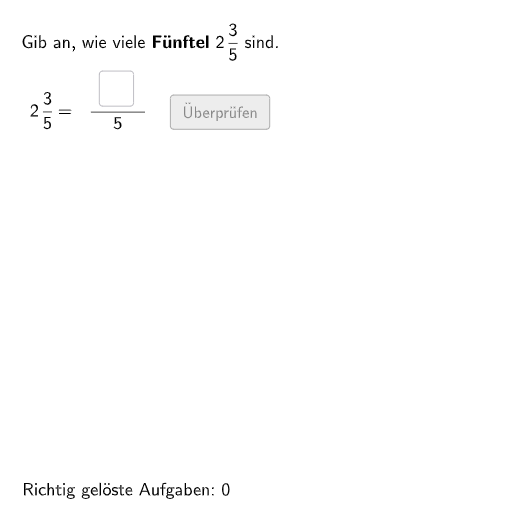
This example demonstrates how to convert a mixed number to an improper fraction and visually represents fraction concepts through geometric figures. The key mathematical concepts include mixed numbers, improper fractions, fraction operations, and geometric construction. The construction involves using GeoGebra commands such as Sequence, Element, Shuffle, Textfield, Polygon, Circle, Segment, Circle
GeoGebra Commands & Parameters
Sequence(Random[1, 3], i, 1, 100) → randomNosGanze, {2, 3, 3, 1, 2, 1, 2, 2, 3, 1, 3, 3, 1, 1, 2, 1, 3, 1, 1, 2, 3, 2, 1, 3, 1, 3, 1, 2, 2, 1, 1, 1, 3, 2, 1, 1, 1, 1, 1, 1, 3, 1, 1, 1, 3, 2, 2, 1, 3, 1, 1, 1, 3, 3, 3, 1, 1, 1, 1, 1, 1, 1, 2, 3, 3, 3, 2, 2, 3, 2, 3, 1, 3, 3, 1, 3, 3, 3, 1, 2, 3, 1, 2, 3, 3, 3, 2, 1, 3, 2, 1, 3, 1, 1, 3, 2, 2, 3, 1, 1}Element(randomNosGanze, Mod[count, 100] + 1) → ganzeShuffle(Sequence[Random[2, 10], i, 1, 100]) → randomNosNenner, {5, 4, 2, 6, 9, 10, 3, 3, 2, 4, 9, 10, 9, 5, 10, 6, 3, 7, 6, 4, 7, 9, 4, 6, 10, 2, 10, 10, 9, 3, 4, 7, 3, 2, 5, 3, 8, 5, 6, 5, 6, 5, 3, 10, 9, 2, 6, 9, 7, 6, 9, 2, 10, 6, 6, 7, 4, 3, 9, 3, 5, 5, 6, 6, 8, 4, 10, 8, 5, 8, 10, 9, 8, 4, 8, 3, 8, 7, 2, 3, 7, 2, 10, 2, 10, 9, 6, 4, 6, 7, 4, 4, 2, 4, 9, 8, 6, 7, 9, 2}Sequence(Random[1, randomNosNenner(i) - 1], i, 1, 100) → randomNosZaehler, {3, 1, 1, 5, 4, 1, 1, 2, 1, 3, 1, 9, 4, 3, 2, 2, 1, 1, 2, 3, 5, 6, 3, 4, 7, 1, 6, 7, 8, 2, 1, 4, 1, 1, 4, 1, 1, 3, 3, 1, 4, 2, 2, 4, 4, 1, 2, 8, 5, 4, 1, 1, 2, 5, 2, 6, 3, 2, 8, 2, 3, 1, 1, 2, 1, 3, 8, 5, 4, 4, 1, 6, 1, 2, 6, 2, 7, 5, 1, 1, 1, 1, 7, 1, 5, 6, 2, 3, 3, 4, 3, 3, 1, 1, 5, 5, 2, 1, 3, 1}Element(randomNosZaehler, Mod[count, 100] + 1) → zaehlerElement(randomNosNenner, Mod[count, 100] + 1) → nennerTextfield(aInput) → InputBox1Textfield(bInput) → InputBox2Polygon(PtopLeftCornerFeedback, PtopRightCornerFeedback, PbottomRightCornerFeedback, PbottomLeftCornerFeedback) → rectangleCorrect, ptopleftcornerfeedback, ptoprightcornerfeedback, pbottomrightcornerfeedback, pbottomleftcornerfeedbackCircle(PM1, radius) → cSequence(Translate[c, ((((2 * radius) * 1.2) * i), 0)], i, 0, ganze) → circlesSegment(PM1, PM1 + (radius * (0, 1))) → fSequence(Rotate[f, ((i * 2) * pi / nenner), PM1], i, 0, nenner - 1) → l2Sequence(Translate[l2, ((((2 * radius) * 1.2) * i), 0)], i, 0, ganze) → circlesSectorsCircleSector(PM1, Rotate[PM1 + (0, radius), ((-2 * pi / nenner) * zaehler), PM1], PM1 + (0, radius)) → dTranslate(d, ((((2 * radius) * 1.2) * ganze), 0)) → d'Take(circles, 1, ganze) → circlesGanzePolygon(A, B, C, D) → q1, a, b, c_1, d_1Sequence(Random[1, 3], i, 1, 100) → randomNosGanze_{1}, {2, 3, 1, 3, 2, 3, 3, 1, 2, 3, 3, 2, 2, 2, 1, 1, 1, 2, 2, 3, 2, 1, 1, 1, 2, 3, 1, 1, 1, 3, 2, 3, 1, 3, 1, 2, 3, 2, 1, 1, 3, 2, 1, 3, 3, 2, 1, 3, 1, 1, 1, 3, 3, 2, 3, 1, 1, 3, 3, 2, 2, 2, 2, 1, 1, 2, 3, 1, 3, 1, 3, 1, 2, 2, 1, 3, 3, 1, 3, 2, 1, 1, 2, 2, 1, 2, 1, 1, 2, 2, 1, 2, 3, 2, 1, 1, 2, 1, 2, 3}Element(randomNosGanze_{1}, Mod[count, 100] + 1) → ganze_{1}Circle(PM1_{1}, radius) → c_{2}Sequence(Random[1, 3], i, 1, 100) → randomNosGanze_{2}, {1, 2, 2, 3, 1, 1, 3, 1, 2, 1, 3, 2, 1, 2, 2, 3, 3, 2, 1, 3, 1, 2, 1, 3, 2, 1, 1, 1, 3, 3, 2, 2, 1, 3, 2, 2, 3, 1, 2, 2, 2, 3, 1, 2, 1, 2, 3, 3, 2, 3, 3, 2, 3, 2, 1, 2, 1, 2, 1, 2, 2, 2, 3, 1, 1, 3, 3, 3, 3, 1, 3, 2, 3, 1, 3, 3, 2, 2, 2, 1, 3, 2, 3, 1, 1, 3, 3, 3, 1, 2, 1, 1, 2, 1, 1, 3, 2, 2, 3, 2}Element(randomNosGanze_{2}, Mod[count, 100] + 1) → ganze_{2}Circle(PM1_{2}, radius) → c_{3}Sequence(Translate[c_{3}, ((((2 * radius) * 1.2) * i), 0)], i, 0, ganze_{2}) → circles_{1}Polygon(E, F, G, H) → v1, e, f_1, g_1, hTake(circles, 1, ganze) → circlesSolution