
From Improper Fractions to Mixed Numbers
Loading the math board and drawing, please wait…
In collections
Wiederholung I: Brüche - Begriffe & Arten
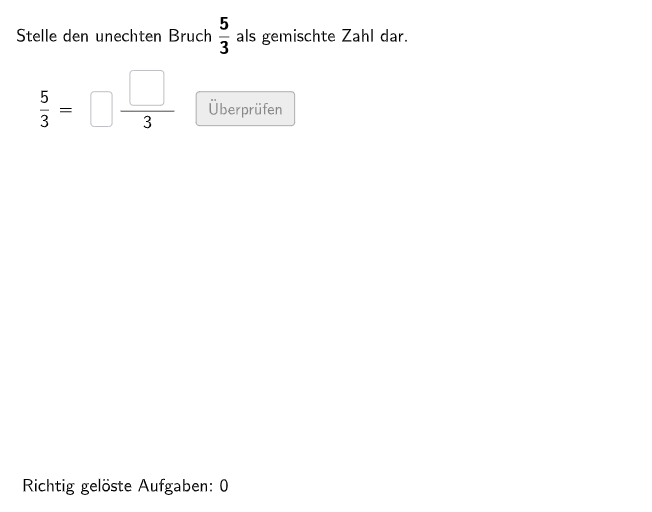
This GeoGebra example demonstrates the conversion process from improper fractions to mixed numbers. It involves the core mathematical concepts of fraction types and mixed numbers. The construction points include using Shuffle, Sequence, and Element commands to generate random fractions and mixed numbers. This example is suitable for elementary and middle school mathematics education, particularly
GeoGebra Commands & Parameters
Shuffle(Sequence[Random[2, 10], i, 1, 100]) → randomNosNenner, {3, 7, 8, 3, 5, 2, 5, 6, 2, 8, 6, 3, 3, 6, 4, 4, 2, 7, 10, 10, 4, 8, 10, 5, 6, 2, 10, 2, 8, 5, 9, 3, 6, 8, 10, 9, 8, 10, 8, 2, 10, 10, 2, 10, 8, 8, 3, 3, 3, 8, 6, 5, 7, 6, 5, 9, 4, 9, 2, 3, 4, 8, 10, 9, 3, 5, 10, 10, 6, 9, 10, 8, 6, 2, 8, 10, 7, 10, 2, 2, 4, 2, 2, 9, 7, 6, 5, 4, 4, 9, 7, 9, 7, 4, 4, 10, 6, 4, 8, 4}Sequence(Random[1, randomNosNenner(i) - 1], i, 1, 100) → randomNosZaehler, {2, 2, 6, 2, 3, 1, 4, 1, 1, 7, 5, 2, 1, 2, 2, 2, 1, 5, 8, 5, 2, 2, 6, 4, 4, 1, 9, 1, 3, 3, 3, 2, 4, 1, 3, 6, 6, 3, 6, 1, 7, 5, 1, 6, 2, 2, 1, 2, 2, 1, 3, 1, 6, 4, 4, 8, 3, 6, 1, 2, 2, 5, 6, 6, 1, 4, 6, 5, 4, 3, 4, 4, 1, 1, 3, 5, 5, 6, 1, 1, 1, 1, 1, 3, 2, 5, 4, 2, 3, 7, 1, 2, 4, 2, 1, 3, 4, 2, 3, 1}Element(randomNosZaehler, Mod[count, 100] + 1) → zaehlerSequence(Random[1, 3], i, 1, 100) → randomNosGanze, {1, 2, 2, 2, 2, 3, 3, 1, 2, 2, 1, 1, 1, 3, 3, 1, 2, 1, 3, 1, 3, 1, 1, 1, 3, 2, 3, 3, 3, 2, 2, 1, 2, 3, 3, 2, 2, 1, 1, 3, 1, 3, 2, 2, 3, 3, 1, 2, 3, 1, 2, 1, 1, 2, 1, 1, 1, 3, 2, 1, 3, 3, 2, 3, 3, 3, 1, 3, 2, 2, 3, 2, 1, 1, 2, 3, 2, 2, 3, 1, 3, 2, 3, 1, 2, 2, 2, 3, 2, 2, 2, 1, 2, 1, 2, 1, 3, 1, 1, 1}Element(randomNosGanze, Mod[count, 100] + 1) → ganzeElement(randomNosNenner, Mod[count, 100] + 1) → nennerTextfield(aInput) → InputBox1Textfield(bInput) → InputBox2Polygon(PtopLeftCornerFeedback, PtopRightCornerFeedback, PbottomRightCornerFeedback, PbottomLeftCornerFeedback) → rectangleCorrect, ptopleftcornerfeedback, ptoprightcornerfeedback, pbottomrightcornerfeedback, pbottomleftcornerfeedbackCircle(PM1, radius) → cSequence(Translate[c, ((((2 * radius) * 1.2) * i), 0)], i, 0, ganze) → circlesSegment(PM1, PM1 + (radius * (0, 1))) → fSequence(Rotate[f, ((i * 2) * pi / nenner), PM1], i, 0, nenner - 1) → l2Sequence(Translate[l2, ((((2 * radius) * 1.2) * i), 0)], i, 0, ganze) → circlesSectorsCircleSector(PM1, Rotate[PM1 + (0, radius), ((-2 * pi / nenner) * zaehler), PM1], PM1 + (0, radius)) → dTranslate(d, ((((2 * radius) * 1.2) * ganze), 0)) → d'Take(circles, 1, ganze) → circlesGanzePolygon(A, B, C, D) → q1, a, b, c_1, d_1Sequence(Random[1, 3], i, 1, 100) → randomNosGanze_{1}, {2, 2, 2, 1, 1, 3, 2, 2, 2, 2, 2, 1, 3, 2, 1, 3, 1, 3, 3, 2, 3, 1, 1, 2, 2, 2, 3, 2, 3, 3, 2, 3, 1, 3, 2, 2, 2, 2, 1, 3, 1, 1, 3, 1, 2, 3, 3, 1, 3, 3, 1, 1, 3, 1, 1, 1, 1, 3, 1, 2, 1, 2, 3, 2, 1, 2, 2, 3, 2, 2, 1, 1, 1, 1, 1, 3, 1, 2, 2, 3, 3, 3, 1, 2, 2, 1, 3, 3, 3, 1, 2, 3, 3, 2, 3, 1, 3, 3, 1, 1}Element(randomNosGanze_{1}, Mod[count, 100] + 1) → ganze_{1}Circle(PM1_{1}, radius) → c_{2}Sequence(Random[1, 3], i, 1, 100) → randomNosGanze_{2}, {1, 1, 1, 3, 1, 1, 2, 1, 3, 3, 1, 3, 1, 3, 3, 3, 2, 1, 3, 2, 3, 2, 2, 1, 2, 3, 2, 1, 3, 2, 3, 2, 3, 1, 1, 2, 2, 2, 3, 3, 3, 2, 3, 3, 1, 2, 1, 2, 2, 3, 3, 1, 2, 3, 2, 2, 1, 2, 2, 1, 3, 1, 2, 2, 3, 1, 1, 1, 1, 1, 3, 3, 3, 3, 1, 1, 1, 3, 3, 2, 1, 1, 1, 3, 2, 2, 1, 2, 1, 1, 2, 1, 1, 1, 3, 1, 1, 3, 3, 1}Element(randomNosGanze_{2}, Mod[count, 100] + 1) → ganze_{2}Circle(PM1_{2}, radius) → c_{3}Sequence(Translate[c_{3}, ((((2 * radius) * 1.2) * i), 0)], i, 0, ganze_{2}) → circles_{1}Polygon(E, F, G, H) → v1, e, f_1, g_1, hTake(circles, 1, ganze) → circlesSolutionPolygon(I, J, K, L) → helpQ1, i, j, k, l