
Fractions with Numerator and Denominator: Visualizing Partition Changes
Loading the math board and drawing, please wait…
In collections
Wiederholung I: Brüche - Begriffe & Arten
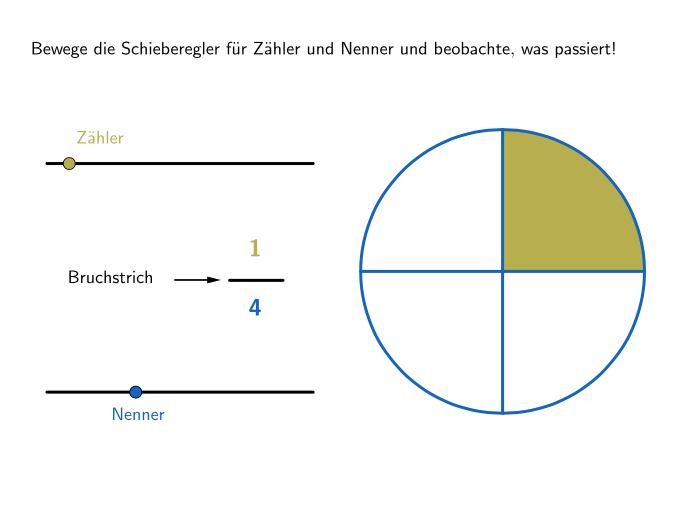
This GeoGebra example uses interactive geometry to show how changing the denominator (while interpreting a fraction as parts of a whole) affects the partition of the whole into equal pieces—whether subdivisions become finer or coarser. Students can also explore the effect of keeping the numerator fixed. The core math concepts are numerator/denominator meanings, fraction as “parts of one whole or m
GeoGebra Commands & Parameters
Sequence(I + ((i * widthNennerBar / 12) * (1, 0)), i, 1, 12) → allowedPositionsNennerBarPoint(allowedPositionsNennerBar) → PNennerCircle(M, B) → cSegment(M, M + (Radius[c] * (0, 1))) → fVector(F, G) → uSegment(H, H + (widthZaehlerBar * (1, 0))) → gSegment(I, I + (widthNennerBar * (1, 0))) → hSequence(H + ((i * widthZaehlerBar / 12) * (1, 0)), i, 0, nenner2) → allowedPositionsZaehlerBarPoint(allowedPositionsZaehlerBar) → PZaehlerSequence(Rotate[f, ((i * 2) * pi / nenner2), M], i, 0, nenner2 - 1) → l1Sequence(CircleSector[M, Rotate[KreisOben, (((-(i + 1)) * 2) * pi / nenner2), M], Rotate[KreisOben, (((-i) * 2) * pi / nenner2) - 0.0001, M]], i, 0, zaehler2 - 1) → l2Segment(pointSegment1, pointSegment2) → bruchstirch1