
Formation of 23-Face Solids: Cone, Cylinder, and Truncated Cone
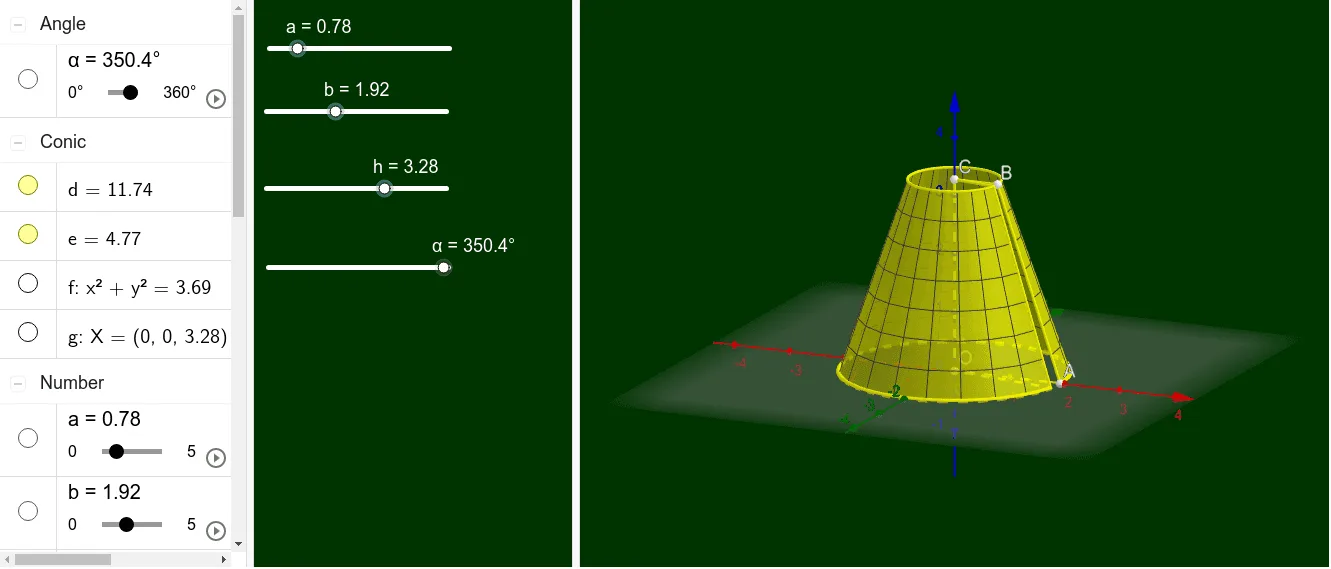
This GeoGebra model demonstrates the formation process of cones, cylinders, and truncated cones through dynamic rotation and construction, providing an in-depth understanding of the principles behind the generation of these solid geometric figures. Interactive manipulation allows for observation of the effects of different parameter changes on the shapes, making it a practical tool for studying solid geometry. The applet animates the rotation of two-dimensional generating surfaces around an axis to form three-dimensional solids, helping students visualize how a rectangular region sweeps out a cylinder, a right triangle sweeps out a cone, and a trapezoid sweeps out a truncated cone. Users can adjust key parameters such as the radius of the base, the height of the solid, and the sweep angle to see real-time changes in the resulting shape. This dynamic exploration supports conceptual understanding of how plane figures relate to their corresponding solids of revolution, reinforcing the connection between two-dimensional geometry and three-dimensional spatial reasoning. The interactive nature of the applet encourages inquiry-based learning, allowing students to experiment with different configurations and observe the geometric consequences directly. It is particularly valuable for learners who benefit from visual and kinesthetic engagement with mathematical concepts, as it transforms abstract definitions into concrete, observable phenomena. The model serves as an effective supplement to traditional instruction in solid geometry, helping students build intuition about the properties and generation of common three-dimensional shapes.
In collections
Minority Pi: Interactive Math Applets
Loading the math board and drawing, please wait…