
Flickering White Dots: Geometric Optical Illusion with Polygons
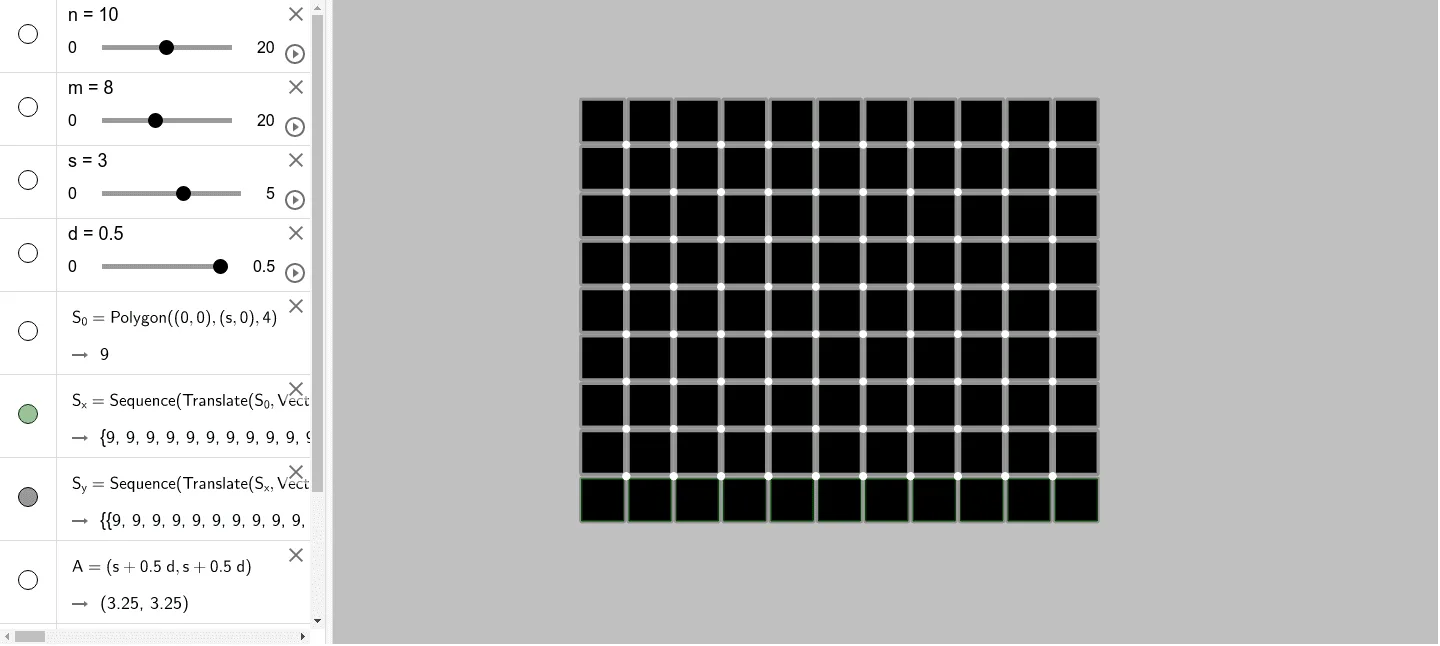
This GeoGebra applet demonstrates a fascinating geometric optical illusion involving flickering white dots that appear and disappear as viewers focus on a pattern constructed from polygons and sequences. The applet uses the Polygon and Sequence commands in combination with adjustable parameter sliders to generate a dynamically evolving geometric figure that creates a compelling visual effect.
The core mathematical concept revolves around how discrete point arrays are arranged according to sequence definitions and how those points serve as vertices for polygonal constructions. By manipulating sliders, users can control parameters such as the number of polygons, their rotational angles, scaling factors, and spacing between elements. These adjustments alter the density and arrangement of the white dots across the canvas, producing regions where dots seem to flicker into visibility or vanish depending on the viewer's point of focus.
The applet explores the intersection of discrete mathematics and human visual perception. It demonstrates how closely spaced geometric elements can trick the eye, creating phantom dots that appear at locations where no actual point exists. This phenomenon occurs due to the way the brain processes high-contrast patterns and fills in gaps between regularly spaced elements, making the demonstration an excellent bridge between abstract mathematical construction and perceptual psychology.
Students benefit from this interactive demonstration in several meaningful ways. First, they gain hands-on experience with the Sequence command, observing how iterative definitions produce structured point distributions. Second, they see how polygon construction depends on vertex ordering and can be dynamically linked to sequence output. Third, the visual illusion aspect makes the mathematics memorable and engaging, encouraging students to experiment with different parameter values and predict the resulting patterns. The slider controls invite inquiry-based learning, as students can systematically vary one parameter at a time to understand its role in the overall structure.
The applet is well suited for classroom use in lessons on sequences, geometric construction, or even interdisciplinary discussions about perception and mathematics. It transforms abstract algorithmic thinking into visible, dynamic results that students can manipulate and explore independently.
In collections
Beauty of Mathematics: GeoGebra Visualizations
Loading the math board and drawing, please wait…