
Find the Corresponding Addition!
Loading the math board and drawing, please wait…
In collections
Erstes Rechnen mit Brüchen - Addieren
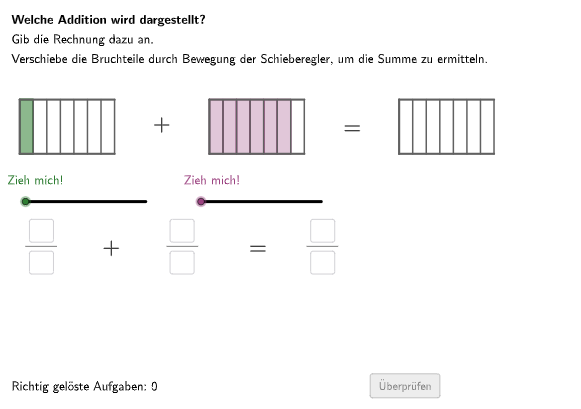
This example demonstrates how to find the sum of two fractions. The core math concepts involved are addition and fractions. The construction points include using GeoGebra's Shuffle, Element, Join, and Segment commands to create fraction graphs. This example is suitable for 5-6 grade students, helping them understand the concepts of addition and fractions.
GeoGebra Commands & Parameters
Shuffle(Sequence[Random[2, 12], i, 1, 100]) → randomNosForNenner, {4, 3, 5, 9, 11, 6, 6, 3, 7, 10, 11, 2, 12, 8, 4, 10, 5, 9, 7, 2, 12, 4, 3, 9, 9, 6, 2, 4, 10, 8, 11, 10, 11, 3, 2, 5, 10, 9, 4, 5, 8, 2, 11, 9, 4, 3, 11, 7, 9, 11, 10, 11, 9, 8, 5, 4, 12, 11, 4, 8, 3, 12, 3, 11, 8, 10, 6, 9, 11, 7, 12, 11, 3, 9, 7, 9, 4, 11, 10, 12, 10, 8, 5, 11, 8, 4, 8, 7, 8, 9, 9, 7, 7, 2, 12, 10, 6, 9, 4, 9}Element(randomNosForNenner, Mod[questionCount, 100] + 1) → nenner2Shuffle(Sequence[Random[1, nenner2 - 1], i, 1, 100]) → randomNosForZaehler2, {6, 6, 2, 1, 2, 3, 1, 4, 1, 3, 6, 2, 3, 1, 1, 1, 6, 4, 3, 2, 6, 6, 1, 5, 6, 5, 4, 6, 1, 3, 1, 6, 5, 2, 4, 1, 1, 5, 6, 6, 5, 4, 3, 4, 4, 2, 4, 2, 5, 6, 2, 1, 3, 6, 1, 5, 1, 4, 2, 1, 3, 1, 6, 4, 1, 6, 4, 4, 1, 5, 4, 4, 6, 4, 3, 5, 5, 4, 3, 2, 4, 5, 5, 5, 6, 5, 6, 6, 5, 6, 1, 6, 5, 4, 4, 4, 2, 1, 2, 3}Element(randomNosForZaehler2, Mod[questionCount, 100] + 1) → zaehler2Shuffle(Sequence[nenner2 - Random[zaehler2, nenner2 - 1], i, 1, 100]) → randomNosForZaehler3, {6, 1, 4, 4, 3, 6, 2, 5, 6, 1, 3, 3, 4, 6, 4, 6, 4, 5, 5, 6, 2, 3, 2, 6, 5, 4, 3, 6, 2, 1, 6, 6, 4, 2, 1, 4, 6, 2, 3, 2, 5, 2, 6, 5, 6, 2, 4, 1, 1, 5, 6, 2, 1, 4, 5, 5, 6, 1, 6, 6, 2, 5, 3, 5, 6, 3, 6, 5, 1, 1, 5, 3, 6, 3, 3, 4, 6, 4, 6, 2, 3, 3, 3, 5, 4, 1, 3, 6, 6, 2, 2, 1, 6, 3, 3, 4, 4, 2, 6, 2}Element(randomNosForZaehler3, Mod[questionCount, 100] + 1) → zaehler3Join({Sequence[Segment[F + ((i * widthZaehlerBar / 12), (-2 * hightLine)), F + ((i * widthZaehlerBar / 12), (2 * hightLine))], i, 0, 0], Sequence[Segment[F + ((i * widthZaehlerBar / 12), (-hightLine)), F + ((i * widthZaehlerBar / 12), hightLine)], i, 0, nenner2], Sequence[Segment[F + ((i * widthZaehlerBar / 12), (-2 * hightLine)), F + ((i * widthZaehlerBar / 12), (2 * hightLine))], i, nenner2, nenner2]}) → streckenStrecken2Last(streckenStrecken2) → referencePoint2Segment(F, P2) → qCircle(A_1, C) → dMirror(Sequence[CircleSector[A_1, Rotate[K, (((-(i + 1)) * 2) * pi / nenner2), A_1], Rotate[K, ((i * (-2)) * pi / nenner2) - 0.0001, A_1]], i, 0, zaehler3 - 1], Line[A_1, A_1 + (0, 1)]) → sectors2Textfield(aInput) → InputBox5Textfield(bInput) → InputBox6Sequence(I + ((i * widthNennerBar / 12) * (1, 0)), i, 1, 12) → allowedPositionsNennerBarPoint(allowedPositionsNennerBar) → PNennerSequence(H_1 + ((i * widthZaehlerBar / 12) * (1, 0)), i, 0, nenner2) → allowedPositionsZaehlerBar1Point(allowedPositionsZaehlerBar1) → PZaehler1Sequence(H + ((i * widthZaehlerBar / 12) * (1, 0)), i, 0, nenner2) → allowedPositionsZaehlerBarPoint(allowedPositionsZaehlerBar) → PZaehlerSequence(E + ((i * widthZaehlerBar / 12) * (1, 0)), i, -4, zaehler2, 0.5) → listeEx1Element(randomNosForZaehler2, Mod[questionCount, 100] + 1) → numXElement(randomNosForZaehler3, Mod[questionCount, 100] + 1) → numYAppend(true, Sequence[If[randomNosForZaehler2(i) ≟ randomNosForZaehler2(i - 1), false, true], i, 2, 100]) → stayXAppend(true, Sequence[If[randomNosForZaehler3(i) ≟ randomNosForZaehler3(i - 1), false, true], i, 2, 100]) → stayYRemove(Sequence[If[stayX(i), randomNosForZaehler2(i), 0], i, 1, 100], Sequence[0, i, 1, 100]) → randomNosForXwithoutRepeatRemove(Sequence[If[stayY(i), randomNosForZaehler3(i), 0], i, 1, 100], Sequence[0, i, 1, 100]) → randomNosForYwithoutRepeatElement(randomNosForXwithoutRepeat, Mod[questionCount, Length[randomNosForXwithoutRepeat]] + 1) → numXwithoutRepeatElement(randomNosForYwithoutRepeat, Mod[questionCount, Length[randomNosForYwithoutRepeat]] + 1) → numYwithoutRepeatDefined(input) → fixed1Circle(A, B) → cSegment(A, A + (Radius[c] * (0, 1))) → gSegment(I, I + (widthNennerBar * (1, 0))) → hSegment(H, H + (widthZaehlerBar * (1, 0))) → iSegment(H_1, H_1 + (widthZaehlerBar * (1, 0))) → jSequence(Rotate[g, ((i * 2) * pi / nenner2), A], i, 0, nenner2 - 1) → StrechenLeftKreisCircle(A_2, D) → eSegment(A_1, A_1 + (Radius[d] * (0, 1))) → kSegment(A_2, A_2 + (Radius[e] * (0, 1))) → lSequence(Rotate[l, ((i * 2) * pi / nenner2), A_2], i, 0, nenner2 - 1) → StreckenKreisRechtsSequence(CircleSector[A, Rotate[KreisOben, (((-(i + 1)) * 2) * pi / nenner2), A], Rotate[KreisOben, (((-i) * 2) * pi / nenner2) - 0.0001, A]], i, 0, zaehler2 - 1) → sectors1Sequence(CircleSector[A_2, Rotate[J, (((-(i + 1)) * 2) * pi / nenner2), A_2], Rotate[J, (((-i) * 2) * pi / nenner2) - 0.0001, A_2]], i, 0, zaehler3 - 1) → sectors3_2Join({Sequence[Segment[E + ((i * widthZaehlerBar / 12), (-2 * hightLine)), E + ((i * widthZaehlerBar / 12), (2 * hightLine))], i, 0, 0], Sequence[Segment[E + ((i * widthZaehlerBar / 12), (-hightLine)), E + ((i * widthZaehlerBar / 12), hightLine)], i, 0, nenner2], Sequence[Segment[E + ((i * widthZaehlerBar / 12), (-2 * hightLine)), E + ((i * widthZaehlerBar / 12), (2 * hightLine))], i, nenner2, nenner2]}) → streckenStrecken1Element(types, 4) → Text3Element(types, 4) → Text4Sequence(E + ((i * widthZaehlerBar / 12) * (1, 0)), i, 0, zaehler2) → streckenPunktLeftIf(zaehler2 ≟ 1, E + ((1 / 12 * widthZaehlerBar) * (1, 0)), If[zaehler2 ≟ 2, E + ((2 / 12 * widthZaehlerBar) * (1, 0)), If[zaehler2 ≟ 3, E + ((3 / 12 * widthZaehlerBar) * (1, 0)), If[zaehler2 ≟ 4, E + ((4 / 12 * widthZaehlerBar) * (1, 0)), If[zaehler2 ≟ 5, E + ((5 / 12 * widthZaehlerBar) * (1, 0)), If[zaehler2 ≟ 6, E + ((6 / 12 * widthZaehlerBar) * (1, 0)), If[zaehler2 ≟ 7, E + ((7 / 12 * widthZaehlerBar) * (1, 0)), If[zaehler2 ≟ 8, E + ((8 / 12 * widthZaehlerBar) * (1, 0)), If[zaehler2 ≟ 9, E + ((9 / 12 * widthZaehlerBar) * (1, 0)), If[zaehler2 ≟ 10, E + ((10 / 12 * widthZaehlerBar) * (1, 0)), If[zaehler2 ≟ 11, E + ((11 / 12 * widthZaehlerBar) * (1, 0)), If[zaehler2 ≟ 12, E + ((12 / 12 * widthZaehlerBar) * (1, 0))]]]]]]]]]]]) → PExampleSequence(F + ((i * widthZaehlerBar / 12) * (1, 0)), i, 0, nenner2) → streckenPunktRightSequence(F + ((i * widthZaehlerBar / 12) * (1, 0)), i, 1, zaehler3, 0.5) → listeEx2If(zaehler3 ≟ 1, F + ((1 / 12 * widthZaehlerBar) * (1, 0)), If[zaehler3 ≟ 2, F + ((2 / 12 * widthZaehlerBar) * (1, 0)), If[zaehler3 ≟ 3, F + ((3 / 12 * widthZaehlerBar) * (1, 0)), If[zaehler3 ≟ 4, F + ((4 / 12 * widthZaehlerBar) * (1, 0)), If[zaehler3 ≟ 5, F + ((5 / 12 * widthZaehlerBar) * (1, 0)), If[zaehler3 ≟ 6, F + ((6 / 12 * widthZaehlerBar) * (1, 0)), If[zaehler3 ≟ 7, F + ((7 / 12 * widthZaehlerBar) * (1, 0)), If[zaehler3 ≟ 8, F + ((8 / 12 * widthZaehlerBar) * (1, 0)), If[zaehler3 ≟ 9, F + ((9 / 12 * widthZaehlerBar) * (1, 0)), If[zaehler3 ≟ 10, F + ((10 / 12 * widthZaehlerBar) * (1, 0)), If[zaehler3 ≟ 11, F + ((11 / 12 * widthZaehlerBar) * (1, 0)), If[zaehler3 ≟ 12, F + ((12 / 12 * widthZaehlerBar) * (1, 0))]]]]]]]]]]]) → PExample1Segment(E, PExample) → mSegment(F, PExample1) → nLast(streckenStrecken1) → referencePoint1Segment(E, P1) → pSegment(G, L) → rSegment(M, N) → sSequence(Segment[(x(M) + t, y(M)), (x(M) + t, y(M) + 2)], t, 0, nenner2 / 2, 0.5) → balken2Sequence(Segment[(x(G) + t, y(G)), (x(G) + t, y(G) + 2)], t, 0, nenner2 / 2, 0.5) → balken1Sequence(L + ((i * widthZaehlerBar / 8) * (1, 0)), i, 0, nenner2) → balkenPunkte1Sequence(G + ((i * widthZaehlerBar / 8) * (1, 0)), i, 0, nenner2) → balkenPunkte2Sequence(N + ((i * widthZaehlerBar / 8) * (1, 0)), i, 0, nenner2) → balkenPunkte3Sequence(M + ((i * widthZaehlerBar / 8) * (1, 0)), i, 0, nenner2) → balkenPunkte4Last(balkenPunkte1) → LastBalkenPunkte1Last(balkenPunkte2) → LastBalkenPunkte2Last(balkenPunkte3) → LastBalkenPunkte3Last(balkenPunkte4) → LastBalkenPunkte4Point(LastBalkenPunkte1) → OSegment(L, O) → tPoint(LastBalkenPunkte2) → PSegment(G, P) → aPoint(LastBalkenPunkte4) → QSegment(M, Q) → bPoint(LastBalkenPunkte3) → RSegment(N, R) → f_1Sequence(Polygon[(i, 5), (i + 0.5, 5), (i + 0.5, 7), (i, 7)], i, -5, zaehler2 / 2 - 5.5, 0.5) → l1Sequence(Polygon[(i, 5), (i + 0.5, 5), (i + 0.5, 7), (i, 7)], i, 2, zaehler3 / 2 + 1.5, 0.5) → l2Translate(sectors1, (schiebeSectors1, 0)) → sectors1'Join({Sequence[Segment[S + ((i * widthZaehlerBar / 12), (-2 * hightLine)), S + ((i * widthZaehlerBar / 12), (2 * hightLine))], i, 0, 0], Sequence[Segment[S + ((i * widthZaehlerBar / 12), (-hightLine)), S + ((i * widthZaehlerBar / 12), hightLine)], i, 0, nenner2], Sequence[Segment[S + ((i * widthZaehlerBar / 12), (-2 * hightLine)), S + ((i * widthZaehlerBar / 12), (2 * hightLine))], i, nenner2, nenner2]}) → streckenStrecken3Last(streckenStrecken3) → referencePoint3Segment(S, P3) → g_1Segment(T, U) → i_1Sequence(Segment[(x(U) + t, y(U)), (x(U) + t, y(U) + 2)], t, 0, nenner2 / 2, 0.5) → balken3Sequence(T + ((i * widthZaehlerBar / 8) * (1, 0)), i, 0, nenner2) → balkenPunkte5Sequence(U + ((i * widthZaehlerBar / 8) * (1, 0)), i, 0, nenner2) → balkenPunkte6Last(balkenPunkte5) → LastBalkenPunkte5Last(balkenPunkte6) → LastBalkenPunkte6Point(LastBalkenPunkte5) → VPoint(LastBalkenPunkte6) → WSegment(T, V) → j_1Segment(U, W) → k_1Sequence(Polygon[(i, 5), (i + 0.5, 5), (i + 0.5, 7), (i, 7)], i, 8, zaehler2 / 2 + 5.5, 0.5) → l3Translate(l1, (schiebeBalken1, 0)) → l1'Translate(l2, (schiebeBalken2, 0)) → l2'Translate(E, (schiebeStrecke1, 0)) → E'Translate(PExample, (schiebeStrecke1, 0)) → PExample'Segment(E', PExample') → m'Translate(F, (schiebeStrecke2, 0)) → F'Translate(PExample1, (schiebeStrecke2, 0)) → PExample1'Segment(F', PExample1') → n'Last(balken1) → l4First(balken2) → l5Midpoint(strecke1) → ZMidpoint(strecke2) → B_1Last(balken2) → l6First(balken3) → l7Midpoint(strecke3) → C_1Midpoint(strecke4) → D_1Segment(Z, B_1) → h_1Segment(C_1, D_1) → l_1Midpoint(h_1) → E_1Midpoint(l_1) → F_1Last(streckenStrecken1) → l8First(streckenStrecken2) → l9Last(streckenStrecken2) → l10First(streckenStrecken3) → l11Point(l8) → G_1Point(l9) → I_1Segment(G_1, I_1) → m_1Point(l10) → J_1Point(l11) → K_1Segment(J_1, K_1) → n_1Midpoint(m_1) → L_1Midpoint(n_1) → M_1Translate(sectors2, (schiebeSectors2, 0)) → sectors2'Mirror(sectors2', gl2) → sectors2''Textfield(input11) → InputBox1Textfield(input21) → InputBox3Textfield(input12) → InputBox2Textfield(input22) → InputBox4Sequence(Sequence[PointInput + ((i * dxInput), (j * dyInput)), i, 0, 2], j, 0, 1) → PosInput, {{(-4.679075080954589, 2.471315735926265), (0.5009249190454108, 2.471315735926265), (5.6809249190454105, 2.471315735926265)}, {(-4.679075080954589, 1.291315735926265), (0.5009249190454108, 1.291315735926265), (5.6809249190454105, 1.291315735926265)}}Translate(PtopLeftCornerFeedback, (dxInput, 0)) → PtopLeftCornerFeedback'Translate(PtopRightCornerFeedback, (dxInput, 0)) → PtopRightCornerFeedback'Translate(PbottomRightCornerFeedback, (dxInput, 0)) → PbottomRightCornerFeedback'Translate(PbottomLeftCornerFeedback, (dxInput, 0)) → PbottomLeftCornerFeedback'Polygon(PtopLeftCornerFeedback', PtopRightCornerFeedback', PbottomRightCornerFeedback', PbottomLeftCornerFeedback') → rectangleCorrect', ptopleftcornerfeedback', ptoprightcornerfeedback', pbottomrightcornerfeedback', pbottomleftcornerfeedback'Translate(sectors1, (schiebeSectors1, 0)) → sectors1'whiteTranslate(sectors2, (schiebeSectors2, 0)) → sectors2'whiteTextfield(zwInput1) → Eingabefeld1Textfield(zwInput2) → Eingabefeld2Textfield(zwInput3) → Eingabefeld3Mod(zaehler2 + zaehler3, nenner2) → solZahler2Mod(solZaehler, nenner2) → solZaehler2If(solGanze2 ≟ 1, zwInput1 ≟ solGanze2, solGanze2 > 1, zwInput2 ≟ solZahler2 ∧ zwInput3 ≟ nenner2, false) → correct51Segment(E, E + ((nenner2 * widthZaehlerBar / 12), 0)) → lineStrecken1Segment(F, F + ((nenner2 * widthZaehlerBar / 12), 0)) → lineStrecken2Segment(S, S + ((nenner2 * widthZaehlerBar / 12), 0)) → linieStrecke4Segment(S, S + ((nenner2 * widthZaehlerBar / 12), 0)) → lineStrecken3Sequence(Rotate[k, ((i * 2) * pi / nenner2), A_1], i, 0, nenner2 - 1) → StreckenKreisMitteLength(n) → lengthLilaLength(lineStrecken3) → lengthGreyDistance(P, E') → PE'
AI Drawing Prompt Reference
Draw a fraction addition example to show the process of adding two fractions. First, create bar graphs for the two fractions, with each bar consisting of multiple segments representing the numerator and denominator. Then, draw connecting line segments between the two bar graphs to represent the addition of the fractions. Finally, add input boxes below the graph to enter the numerators and denominators of the two fractions, and display the calculation result next to it.
The prompt above was compiled from the original drawing commands and is for reference only.