
Escher Tessellation
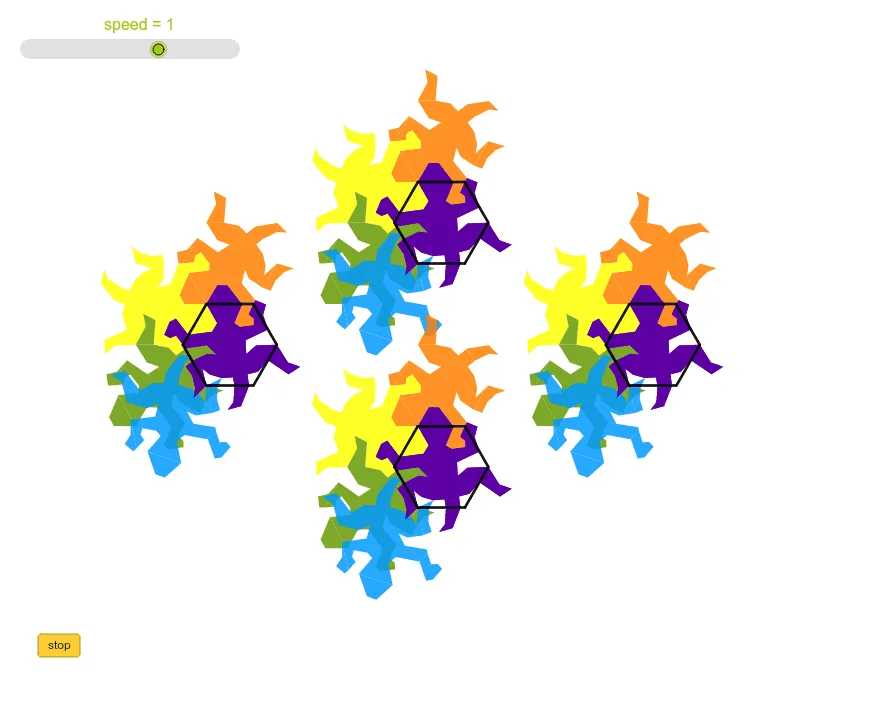
This GeoGebra applet demonstrates an Escher-style tessellation of the plane, showcasing the beautiful intersection of mathematics and art. The construction draws inspiration from the renowned Dutch artist M.C. Escher, whose intricate tiled patterns are celebrated for their seamless interlocking designs and remarkable use of symmetry.
Built using GeoGebra commands such as Polygon, If, and Sequence, the applet constructs interlocking frog-like shapes and tiles them seamlessly across the plane. The underlying mechanism relies on geometric transformations, including translations, rotations, and reflections, which together ensure that every tile fits perfectly with its neighbors without gaps or overlaps. The Sequence command plays a central role in generating the periodic repetition of the base motif, while the If command helps define which parts of the polygon belong to the visible shape, enabling the creation of organic, animal-like forms from simple geometric primitives.
The applet illustrates several fundamental mathematical principles. First, it demonstrates the conditions under which polygons can tessellate a plane, a topic rooted in Euclidean geometry and the study of tiling patterns. Second, it introduces students to the concept of symmetry groups, showing how different combinations of transformations generate distinct periodic patterns. Third, it provides a visual introduction to transformational geometry, allowing learners to observe firsthand how translations, rotations, and reflections preserve shape and size while repositioning figures across the plane.
Students interacting with this applet can explore the construction step by step, modify parameters, and observe how changes affect the overall tessellation. This hands-on experimentation deepens their understanding of abstract concepts such as congruence, periodicity, and group theory at an introductory level. The visual richness of the frog-themed design also makes the material more engaging and accessible, bridging the gap between aesthetic appreciation and mathematical reasoning.
This applet is an excellent teaching resource for lessons on plane tessellation, symmetry, and geometric transformations. It is particularly well suited for secondary school curricula covering transformation geometry, introductory group theory, and the mathematical foundations of art and design.
Loading the math board and drawing, please wait…