
Ellipsograph of Parallelogram Construction
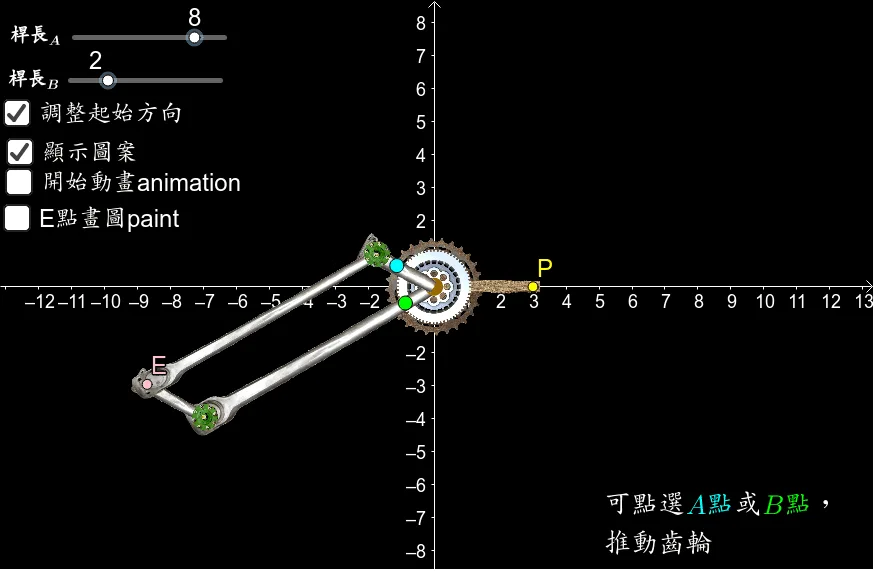
This example demonstrates the construction of an ellipsograph based on a parallelogram linkage mechanism. Using geometric objects such as points, circles, segments, angles, and rotation transformations, it illustrates how the motion properties of a parallelogram can trace an elliptical locus. The construction showcases how a linkage mechanism converts rotational motion into elliptical trajectory motion, representing a classic application in geometric construction and locus problems. Users can interact with the applet by dragging key points to observe how the parallelogram linkage dynamically generates an ellipse. This hands-on exploration helps students visualize the relationship between rigid-body kinematics and conic sections, reinforcing understanding of parametric equations of ellipses through physical analog models. The applet also allows adjustment of linkage lengths and pivot positions, enabling learners to investigate how different parameters affect the shape and dimensions of the resulting ellipse. While the author notes that this design requires further refinement before it can be practically implemented in a real-world physical environment, it serves as an excellent theoretical and pedagogical tool for exploring the mathematical principles behind ellipsograph mechanisms. The interactive nature of the construction makes abstract concepts tangible, supporting deeper comprehension of geometric transformations and their applications in mechanical design.
In collections
Conic Sections
Loading the math board and drawing, please wait…