
Dynamic Hand-in-Hand Model of Triangles
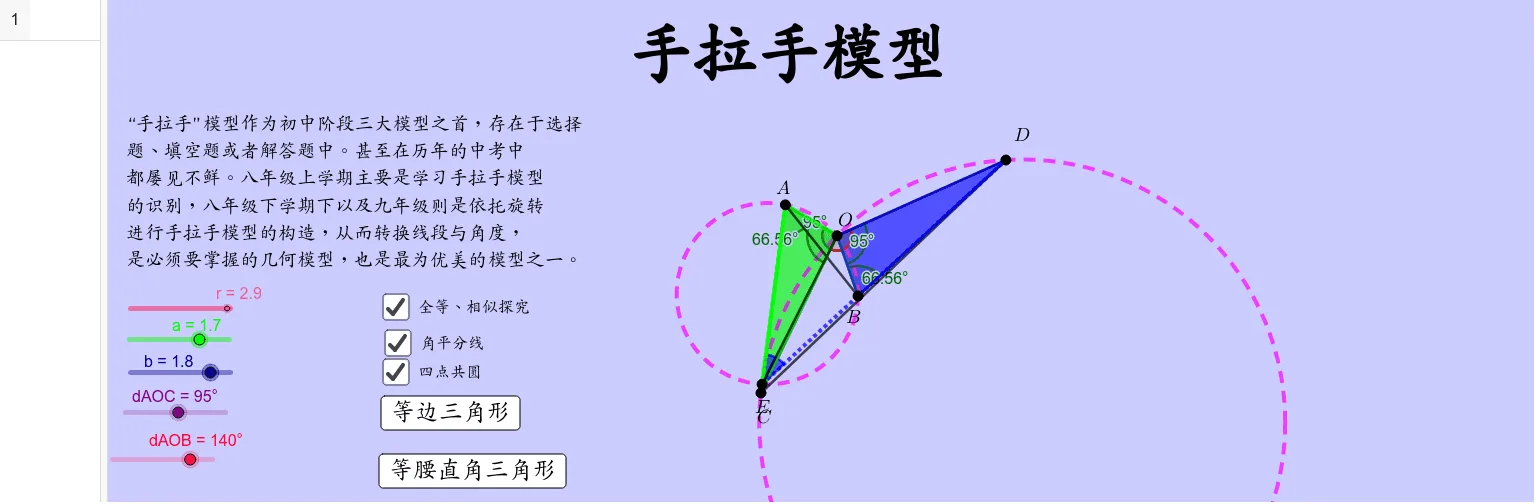
This GeoGebra applet dynamically demonstrates the classic Hand-in-Hand geometric model, a fundamental and powerful configuration in plane geometry. By constructing two triangles that share a common vertex and applying continuous geometric transformations such as rotation and dilation, the applet vividly illustrates the congruence and similarity relationships that emerge as the triangles move. This model is widely used to explore invariant properties like corresponding segment lengths, angle measures, and the internal structures of newly formed polygons, serving as an essential tool for solving complex geometric proofs and calculation problems.
In the interactive environment, users can manipulate the shared vertex, adjust the base side lengths, and use sliders to control the angle of rotation and the scale factor for dilation. As one triangle rotates or scales relative to the other around the common vertex, the applet automatically draws the segments connecting their non-shared vertices, which represent the hands holding each other in the Hand-in-Hand model. Students can observe in real time how these connecting segments maintain specific length ratios and intersect at constant angles, regardless of the rotational position.
The core mathematical concepts highlighted by this applet include spiral similarity, rigid transformations, and triangle congruence criteria such as Side-Angle-Side. When the two initial triangles are similar, the triangles formed by connecting their corresponding free vertices are also similar or congruent. The applet visually proves that the angle between the connecting segments is equal to the vertex angle of the original triangles, and the ratio of their lengths matches the similarity ratio of the initial triangles.
For students and educators, this dynamic visualization bridges the gap between abstract geometric theorems and intuitive spatial reasoning. Instead of relying solely on static textbook diagrams, learners can experiment with the parameters to discover geometric invariants on their own. It is particularly beneficial for students preparing for advanced mathematics competitions, as the Hand-in-Hand model frequently appears in challenging geometry problems involving cyclic quadrilaterals, hidden congruent triangles, and locus trajectories. By interacting with this applet, students develop a deeper, more flexible understanding of geometric transformations, significantly enhancing their ability to construct auxiliary lines and devise elegant proofs for intricate spatial relationships.
In collections
Lumei Junior High Geometry Models
Loading the math board and drawing, please wait…