
Demonstration of Drawing Rectangles on Grid Paper
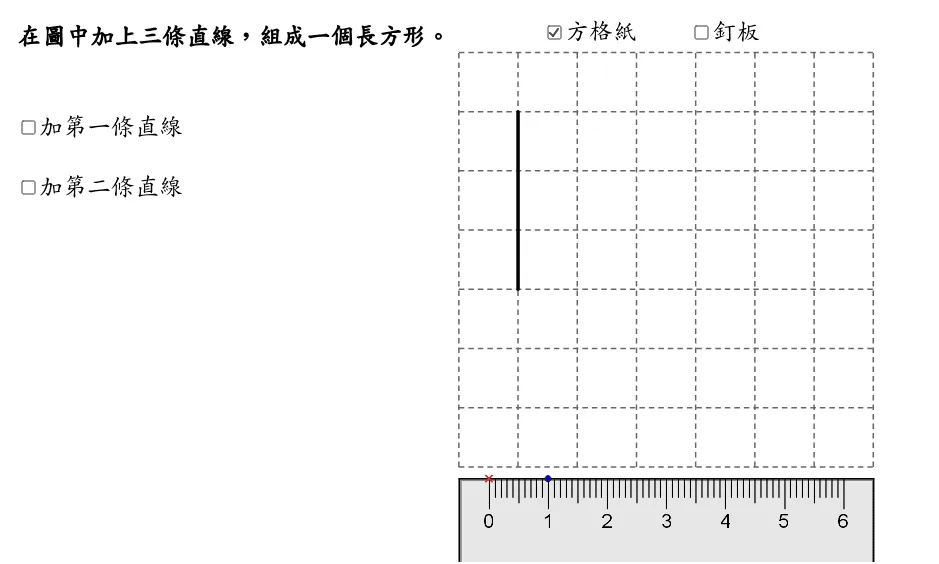
This GeoGebra example demonstrates geometric construction techniques for drawing rectangles on grid paper or geoboards. Utilizing fundamental commands such as points, segments, polygons, and vectors, it dynamically illustrates the generation process of a rectangle. The example also incorporates translation and rotation operations, intuitively marking equal sides, right angles, and parallel sides to reinforce key geometric properties.
Through interactive manipulation, learners can explore how a rectangle is constructed step by step using basic geometric elements. The applet highlights the role of vectors, including unit vectors and orthogonal unit vectors, in defining the shape and orientation of a rectangle on a grid. By dragging vertices or adjusting parameters, users observe how the rectangle responds dynamically while preserving its defining properties: opposite sides remain equal and parallel, all interior angles stay at ninety degrees, and adjacent sides remain perpendicular throughout any transformation.
Translation and rotation operations are seamlessly integrated, allowing students to reposition and reorient the rectangle while maintaining its intrinsic geometric characteristics. Visual annotations make it immediately clear which sides are congruent, which angles are right angles, and which sides are parallel, providing concrete evidence of the rectangle's properties in every configuration.
This applet serves as an effective teaching tool for middle and high school geometry students studying quadrilaterals and coordinate geometry. It supports visual learners by combining dynamic construction with explicit labeling, helping students connect abstract definitions with observable geometric behavior. Educators can use it to introduce formal proofs about rectangles, demonstrate the effect of rigid transformations on geometric figures, or provide guided practice in identifying and verifying rectangle properties on a coordinate grid. The intuitive interface encourages exploration and discovery, making it suitable for both independent learning and classroom demonstration.
Loading the math board and drawing, please wait…