
Decimal to Fraction Conversion
Loading the math board and drawing, please wait…
In collections
Wiederholung II: Erweitern & Kürzen, Darstellungsarten
Bruchzahlen in endliche Dezimalzahlen umrechnen
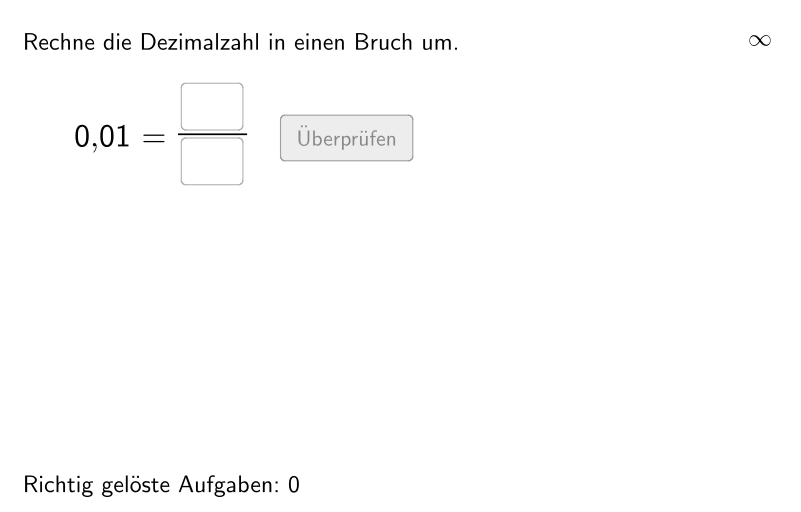
This example demonstrates how to convert decimal numbers to fractions. It involves the key mathematical concepts of fraction representation and conversion between decimal and fraction forms. The construction points include using GeoGebra's Shuffle, Append, Remove commands to generate random fractions and decimal numbers. Suitable for middle school math education, particularly for students learning
GeoGebra Commands & Parameters
Shuffle(Sequence[Random[1, 99], i, 1, 100]) → randomNosForX, {60, 50, 46, 34, 33, 98, 86, 7, 63, 76, 75, 68, 5, 27, 69, 93, 97, 45, 55, 12, 8, 10, 7, 46, 94, 33, 33, 57, 57, 9, 88, 25, 58, 93, 35, 27, 92, 10, 30, 20, 87, 93, 56, 91, 49, 14, 35, 56, 60, 30, 31, 79, 21, 32, 3, 98, 18, 64, 24, 82, 27, 44, 62, 82, 16, 72, 55, 72, 14, 46, 69, 3, 32, 55, 12, 99, 17, 66, 88, 89, 74, 53, 3, 36, 65, 16, 61, 86, 27, 89, 70, 43, 18, 7, 36, 22, 12, 92, 38, 5}Shuffle(Sequence[Random[1, 9], i, 1, 100]) → randomNosForY, {2, 1, 3, 8, 6, 9, 9, 9, 8, 6, 7, 8, 9, 3, 6, 8, 8, 3, 7, 4, 8, 8, 3, 7, 8, 7, 8, 1, 7, 9, 3, 3, 1, 4, 5, 2, 2, 7, 3, 8, 8, 1, 6, 1, 3, 6, 3, 1, 4, 6, 2, 2, 5, 7, 9, 9, 1, 2, 8, 7, 1, 6, 9, 2, 8, 1, 9, 5, 4, 7, 7, 5, 2, 8, 7, 6, 7, 4, 3, 3, 9, 3, 5, 4, 6, 5, 7, 8, 1, 3, 2, 3, 4, 3, 8, 7, 9, 7, 3, 7}Shuffle(Sequence[Random[1, 3], i, 1, 100]) → randomNosForZ, {1, 2, 2, 1, 1, 1, 1, 2, 2, 1, 3, 1, 3, 3, 2, 2, 1, 2, 2, 2, 3, 1, 1, 1, 1, 3, 2, 3, 2, 2, 3, 3, 2, 1, 3, 3, 1, 2, 1, 2, 1, 2, 3, 3, 1, 3, 3, 2, 3, 1, 1, 3, 2, 2, 2, 1, 3, 3, 1, 2, 3, 1, 3, 1, 3, 1, 1, 1, 3, 1, 3, 2, 2, 2, 3, 2, 2, 1, 3, 2, 1, 3, 2, 3, 2, 2, 1, 1, 1, 3, 2, 1, 3, 2, 2, 2, 2, 2, 2, 1}Append(true, Sequence[If[randomNosForZ(i) ≟ randomNosForZ(i - 1), false, true], i, 2, 100]) → stayZRemove(Sequence[If[stayZ(i), randomNosForZ(i), 0], i, 1, 100], Sequence[0, i, 1, 100]) → randomNosForZwithoutRepeatElement(randomNosForZwithoutRepeat, Mod[questionCount, 100] + 1) → numZAppend(true, Sequence[If[randomNosForY(i) ≟ randomNosForY(i - 1), false, true], i, 2, 100]) → stayYRemove(Sequence[If[stayY(i), randomNosForY(i), 0], i, 1, 100], Sequence[0, i, 1, 100]) → randomNosForYwithoutRepeatAppend(true, Sequence[If[randomNosForX(i) ≟ randomNosForX(i - 1), false, true], i, 2, 100]) → stayXRemove(Sequence[If[stayX(i), randomNosForX(i), 0], i, 1, 100], Sequence[0, i, 1, 100]) → randomNosForXwithoutRepeatIf(numZ ≟ 1, Element[randomNosForXwithoutRepeat, Mod[questionCount, 100] + 1], If[numZ ≟ 2, Element[randomNosForYwithoutRepeat, Mod[questionCount, 100] + 1], (Element[randomNosForYwithoutRepeat, Mod[questionCount, 100] + 1] * 10)]) → numXTextfield(input2) → AInputBox1Textfield(input1) → AInputBox2Corner(zahlText, 3) → CornerPolygon(PtopLeftCornerFeedback, PtopRightCornerFeedback, PbottomRightCornerFeedback, PbottomLeftCornerFeedback) → rectangleCorrect, ptopleftcornerfeedback, ptoprightcornerfeedback, pbottomrightcornerfeedback, pbottomleftcornerfeedbackDefined((input1 * input2)) → fixedSegment(Corner + (0.03, -0.275), Corner + (1, -0.275)) → bruchstrichDenominator(dez) → nennerNumerator(dez) → zaehlerIf(Mod[numX, 10] ≟ 0, numX / 10 ≟ saveZaehler, numX ≟ saveZaehler) → correct1If(numX < 10, 1000, If[numX ≥ 10 ∧ numX < 100, 100, If[numX ≥ 100, 10]]) → gesuchterNenner